
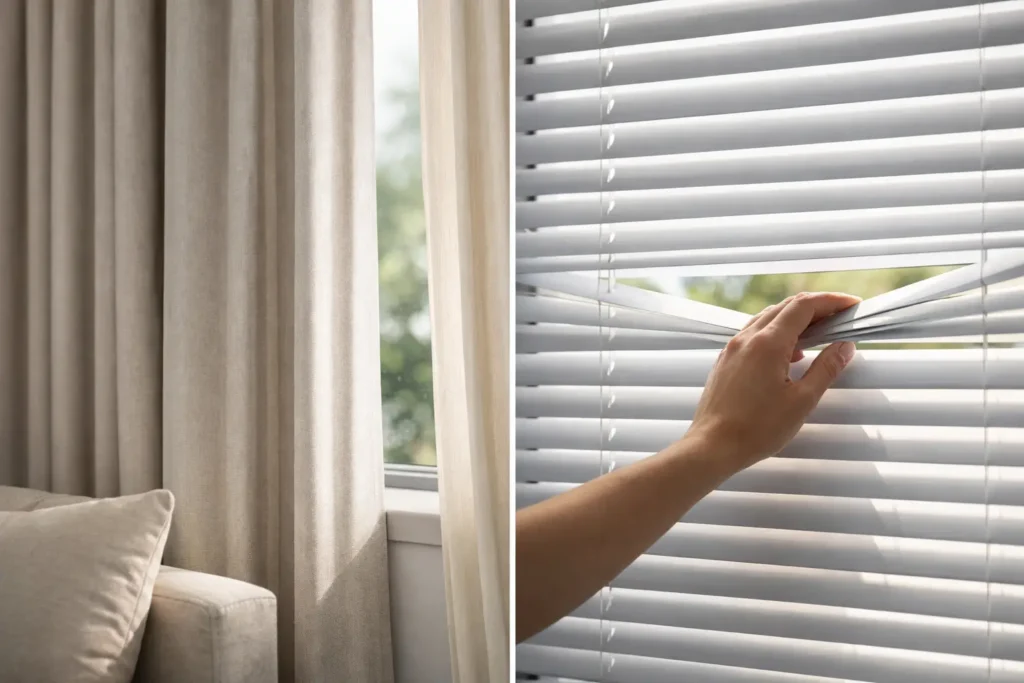

A window can look beautifully dressed and still leave you feeling oddly exposed after dark. That is the real question behind curtains vs blinds privacy: not simply which option looks better, but which one lets you relax in your own home without blocking every bit of daylight.
For most homes, neither treatment wins in every room. Curtains tend to provide fuller coverage and a softer, cozier look, while blinds offer more precise control over light and sightlines. The best choice depends on where the window sits, how close your neighbors are, whether you rent, and how much daily adjusting you are willing to do.
Curtains vs Blinds Privacy: The Quick Answer
If complete visual privacy is your top priority, curtains usually have the edge. Properly sized panels can cover the entire window, including the small gaps that often appear around blinds. A lined or blackout curtain is especially effective at night, when interior lights make it easier for people outside to see in.
Blinds are often better when you want privacy without turning the room dark. You can tilt the slats to redirect views while still letting daylight filter through. That makes them useful in kitchens, bathrooms, and street-facing rooms where you want to control the view throughout the day.
The most private and flexible setup is often both: blinds for daytime adjustment, paired with curtains for full coverage at night. It is a layered look that feels polished, but it is also wonderfully practical.
Why Nighttime Privacy Changes the Decision
Many window treatments feel private during the day because outdoor daylight is brighter than the light inside your home. Once the sun goes down and lamps switch on, that balance flips. A sheer curtain, loosely fitted blind, or shade with visible side gaps can suddenly reveal silhouettes and movement inside.
This is why a treatment that seems perfectly fine at noon may not work for a bedroom, nursery, or living room used after dark. Before buying anything, stand outside near the window in the evening, or ask someone you trust to check from the sidewalk. You may discover that the concern is less about the window itself and more about the angle of view.
For ground-floor rooms and windows facing a neighbor’s driveway, think beyond the glass. A window treatment should cover the areas people can realistically see into, including the lower half of a tall window or the narrow gap beside a blind.
When Curtains Are the Better Privacy Choice
Curtains work best when you need broad, reliable coverage and want the room to feel warmer at the same time. They are particularly helpful in bedrooms, family rooms, and rental spaces with older windows that are not perfectly square.
Choose a fuller fabric for real coverage
Sheer curtains add softness, but they are not a dependable privacy solution at night. For a bedroom or a room that faces another home, look for lined panels, room-darkening curtains, or blackout curtains. Blackout fabric is not only for sleep – it also provides a strong barrier between your home and the outside view.
A medium-weight woven fabric can be a nice compromise in a living room. It feels less heavy than blackout material but still offers meaningful coverage once closed. If you love the airy look of sheers, layer them behind solid curtain panels so you can enjoy soft daylight without giving up evening privacy.
Size and installation matter more than many people expect
Curtains need enough width to close without stretching flat across the window. A good rule is to use total panel width that is about one-and-a-half to two times the width of the window. Fullness creates a more inviting look and limits small openings between folds.
Mounting the rod wider than the window frame also helps. Letting the panels extend several inches past each side of the glass reduces those revealing side gaps. For the most complete coverage, choose a wraparound curtain rod that curves toward the wall at each end.
Watch for light gaps at the top and sides
Even blackout curtains can leave a glow around the edges. That may be perfectly acceptable in a living room, but it can be frustrating in a bedroom where privacy and sleep are equally important. A wider rod, longer panels, and a closer-to-the-wall rod placement can make a noticeable difference without a major expense.
When Blinds Are the Better Privacy Choice
Blinds shine in rooms that need frequent, fine-tuned control. Rather than choosing between fully open and fully closed, you can adjust the slats depending on the time of day and the direction of the sun.
Tilted slats can protect views while keeping daylight
In a bathroom, kitchen, or home office, closing blinds completely can make the room feel gloomy. With horizontal blinds, tilting the slats upward usually allows light to bounce toward the ceiling while limiting direct views from outside. It is a simple adjustment, but it can make a room feel bright and protected at once.
Keep in mind that slatted blinds are not fully private from every angle. Someone standing below or above the window may still be able to see through the slats, especially at night. They work best when the window is not directly visible from a nearby second-story window, porch, or walkway.
Consider the material and fit
Faux wood and wood blinds give a classic, substantial look and often feel more finished than lightweight vinyl options. Aluminum blinds are budget-friendly and easy to wipe clean, which can make them a sensible pick for kitchens and utility spaces. For bathrooms, moisture-resistant faux wood or vinyl is generally a safer choice than real wood.
The fit is just as important as the material. Inside-mounted blinds sit within the window frame and can leave narrow gaps on the sides. Outside-mounted blinds overlap the frame and provide better coverage, especially on shallow windows or windows with uneven trim.
Shades Belong in the Conversation Too
Although the usual curtains vs blinds privacy debate focuses on those two familiar choices, shades can solve problems that neither handles perfectly. Cellular shades, Roman shades, and roller shades create a continuous panel of coverage rather than relying on slats.
Top-down, bottom-up cellular shades are especially useful for bathrooms and street-facing living rooms. You can cover the lower part of the window where privacy is needed while leaving the top open for daylight and a view of the sky. They are one of the most practical options for a home that feels close to its neighbors.
For bedrooms, blackout roller shades can offer strong coverage with a clean, minimal look. Just be aware that many roller shades still leave small light gaps at the sides unless they are paired with curtains or installed in a special track system.
The Best Choice by Room
Bedrooms usually benefit from blackout curtains, blackout shades with curtain panels, or a similar layered setup. The goal is not only privacy but also better sleep, especially if the room faces a streetlight or early morning sun.
Bathrooms call for moisture-friendly materials and easy adjustment. Blinds, privacy shades, or top-down, bottom-up shades are often more practical than long fabric curtains. If you do choose curtains, keep the fabric well away from wet areas.
Living rooms are where style and flexibility can work together. Blinds or shades can handle daytime glare, while curtain panels add softness, color, and evening privacy. This combination makes a standard window feel more intentionally decorated without requiring a full room makeover.
In kitchens, avoid treatments that are difficult to clean near cooking areas. Faux wood blinds, simple roller shades, or woven shades with a privacy liner are easier to live with than fabric panels that can absorb odors or collect splatters.
A Budget-Friendly Layering Strategy
You do not need custom window treatments to make a room feel private. Start with an affordable blind or shade for the basic function, then add ready-made curtains to improve coverage and bring in personality. This approach is especially useful for renters because you can often install tension rods, temporary brackets, or lightweight curtain rods with minimal fuss.
Choose neutral blinds or shades if you want a flexible foundation, then let curtain fabric do the decorating work. A warm oatmeal linen-look panel, soft sage cotton, or a subtle patterned curtain can make the room feel like yours while the practical layer quietly handles privacy.
If budget allows for only one upgrade, prioritize the window that affects your comfort most. The bedroom window facing a neighbor is usually a better investment than a rarely used window in a tucked-away room.
The Privacy Mistakes to Avoid
The biggest mistake is choosing a treatment based on its daytime appearance alone. Test how it works after dark before deciding the job is done. Another common issue is buying curtains that are too narrow or too short, which can make even a lovely fabric look skimpy and leave unnecessary gaps.
With blinds, avoid assuming closed slats mean complete privacy. Check the view from outdoors, particularly if your home sits on a slope or faces multi-level buildings. And if cords are present, use cordless options or proper safety devices in homes with young children or pets.
Your window treatments do not have to be perfect to make a meaningful difference. A well-fitted blind, a pair of fuller curtain panels, or one thoughtful layer can turn a window from a source of self-consciousness into a cozy part of a home you love.
How I Would Choose for Different Homes
If I were helping someone choose window treatments, I would start with the layout of the home rather than the style of the window.
A bedroom that faces a neighbor’s house has very different privacy needs than a second-floor office overlooking a backyard. Likewise, a kitchen that gets beautiful morning light deserves a different solution than a media room where glare is the biggest frustration.
In my experience, homeowners are usually happiest when they stop looking for one perfect window treatment for the entire house. Different rooms solve different problems, and mixing curtains, blinds, or shades where each makes the most sense almost always leads to a home that feels more comfortable.
Rather than asking, “Should I install curtains or blinds everywhere?”, ask yourself three questions:
When do I use this room the most? Who can realistically see inside? How often am I willing to adjust the window treatment?
Those answers usually make the right choice surprisingly clear.
Final Thoughts From Experience
After comparing countless window treatment ideas over the years, I’ve found that privacy is rarely about choosing the “best” product. It’s about understanding how you actually live in each room.
One mistake I see people make is treating every window the same. They buy matching blinds or matching curtains for the entire house because it looks consistent in the store, only to realize later that the bedroom still feels exposed at night or the kitchen has become darker than necessary.
The homes that feel the most comfortable usually use window treatments intentionally. Bedrooms often benefit from maximum privacy and light control, while living rooms can balance natural light with softer layers. Bathrooms, kitchens, and home offices each have their own practical needs, and choosing for those needs almost always leads to a better result than following one decorating rule everywhere.
If you’re still deciding between curtains and blinds for privacy, focus less on what looks best in a catalog and more on how the window functions every day. Walk through your home in the evening, notice where privacy actually matters, and choose the solution that makes those spaces feel relaxed and comfortable. When a window treatment works well, you stop thinking about it—and that’s usually the best sign you’ve made the right choice.
About the Author
Fher is an architect specializing in residential design and space optimization. With hands-on experience improving how homes function and feel, he shares practical insights to help homeowners create spaces that are both beautiful and livable.



Pingback: 10 Best Cozy Bedroom Lighting Ideas to Try - everydayhomestyle.io
Pingback: Sustainable Home Trends That Work in Real Life - everydayhomestyle.io