
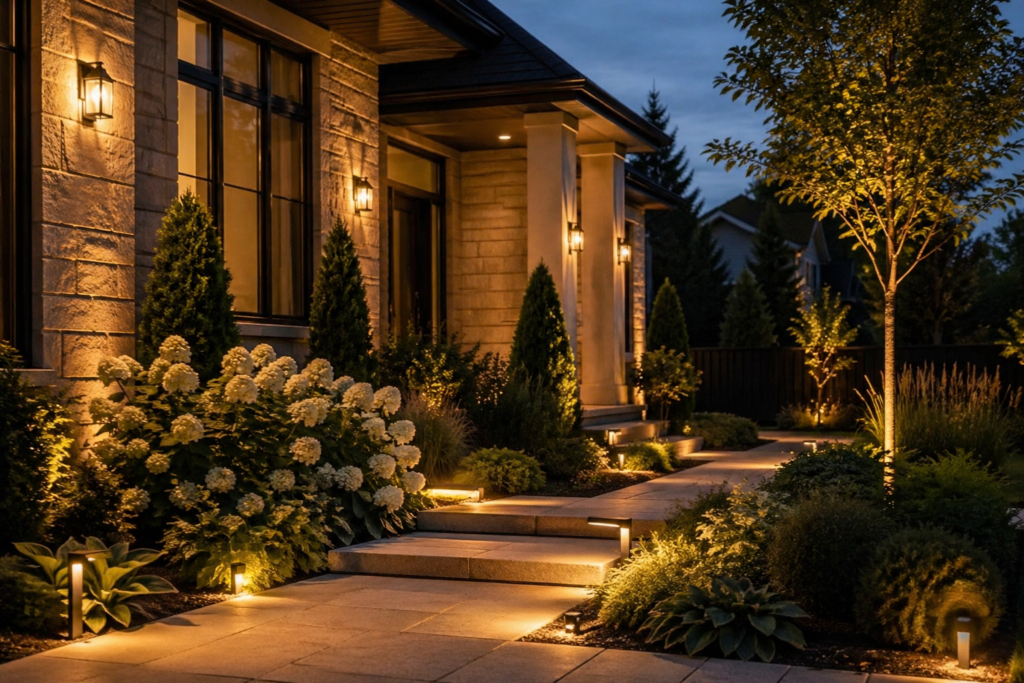

Outdoor lighting has the power to completely transform how your home looks and feels at night.
But in many homes I’ve worked on, lighting is treated as an afterthought — something added at the end, without a clear plan.
The result?
Spaces that feel flat, unsafe, or even uncomfortable.
In this guide, I’ll walk you through the most common outdoor lighting mistakes I see as an architect — and how to fix them using practical, real-world solutions.
1. Relying on a Single Light Source
One of the most common mistakes is using just one main light, usually near the entrance or garage.
This creates:
- Harsh shadows
- Poor visibility
- An unbalanced look
In real projects, I always recommend layered lighting instead.
✔️ What works better:
- Ambient lighting (general illumination)
- Path lighting (for walkways)
- Accent lighting (to highlight architectural features)
👉 When combined, these create depth and a more natural nighttime environment.
2. Using the Wrong Light Temperature
This is a subtle mistake that has a big impact.
Many homeowners install lights that are too cold (bluish), thinking they look “modern”.
In reality, they often make the home feel:
- Unwelcoming
- Harsh
- Almost commercial
✔️ My recommendation:
- Use warm light (2700K–3000K) for most residential outdoor areas
In several homes I’ve worked on, simply changing the light temperature made the space feel instantly more inviting — without changing fixtures.
3. Poor Placement That Creates Shadows
Lighting is not just about brightness — it’s about direction.
I often see lights placed:
- Too high
- Pointing in the wrong direction
- Without considering obstacles
This creates awkward shadows and uneven illumination.
✔️ What to do instead:
- Place lights at human scale when possible
- Use indirect lighting to soften the effect
- Test placement at night before final installation
👉 Good lighting should feel natural, not forced.
4. Ignoring Pathways and Safety Areas
This is more than a design issue — it’s a functional one.
Many homes have beautiful lighting…
but completely ignore:
- Walkways
- Steps
- Entry transitions
✔️ Why this matters:
- Reduces risk of accidents
- Improves usability at night
- Enhances overall experience of the space
In my experience, properly lit pathways make a home feel more complete and intentional.
5. Overlighting the Space
More light does not mean better design.
Overlighting creates:
- Visual discomfort
- Light pollution
- Loss of ambiance
I’ve seen outdoor spaces that feel more like parking lots than homes because of excessive lighting.
✔️ Better approach:
- Use fewer lights, placed strategically
- Focus on contrast and balance
- Let some areas remain softly lit
👉 Darkness is part of good design.
6. Not Highlighting Architectural Features
Outdoor lighting is a powerful tool to enhance your home’s design — but many people don’t use it that way.
Instead, they:
- Light everything equally
- Miss opportunities to create focal points
✔️ What I recommend:
- Highlight textures (stone, wood, walls)
- Use uplighting for vertical elements
- Emphasize entry points
In several projects, this alone elevated the perceived value of the home at night.
7. Choosing Fixtures Based Only on Style
This is a mistake I see very often.
A fixture may look great in a catalog — but:
- Doesn’t provide the right light
- Doesn’t suit outdoor conditions
- Ages poorly over time
✔️ What to consider:
- Durability (weather resistance)
- Light distribution
- Maintenance requirements
👉 Good lighting is both aesthetic and functional.
8. Skipping Planning and Installation Strategy
Outdoor lighting should never be random.
Without a plan, you end up with:
- Inconsistent lighting
- Poor wiring decisions
- Difficult maintenance later
✔️ What works better:
- Define zones (entry, garden, pathways)
- Plan lighting before installation
- Think long-term (not just immediate effect)
In my work, planning is what separates a “nice” result from a truly well-designed space.
Final Thoughts (From Experience)
Outdoor lighting is one of the most underestimated elements in home design.
Done right, it can:
- Improve safety
- Enhance architecture
- Create atmosphere
Done wrong, it can make even a well-designed home feel incomplete.
From my experience, the key is simple:
👉 Design lighting with intention, not just decoration.