
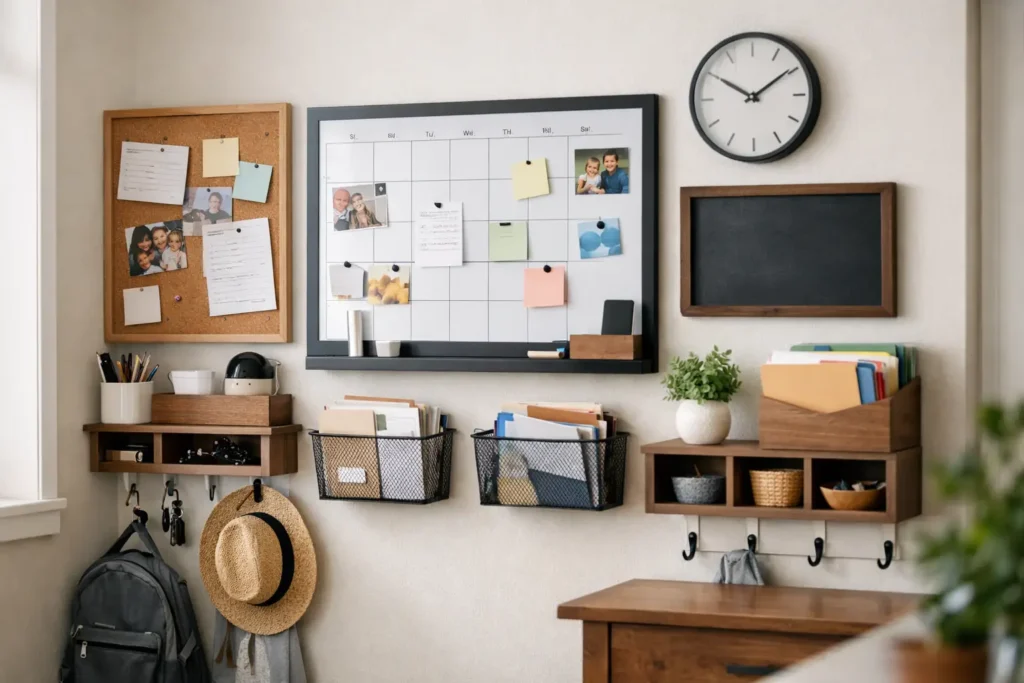

The school form is somewhere on the counter. A package needs returning. Your child has a dentist appointment next Tuesday, and dinner is still a question mark at 4:30. The best family command center ideas do not try to make family life look perfectly organized. They give the everyday pieces of a busy home one dependable place to land.
A command center can be as simple as a narrow wall near the kitchen or as contained as the inside of a cabinet door. What matters is that it suits your household’s actual rhythms, not a picture-perfect version of them. Start with the friction points that make your days feel scattered, then build only what will help.
Start With the Right Spot
The ideal location is where people naturally pass through and where you are likely to notice what is posted. For many homes, that is a wall near the kitchen, the mudroom drop zone, or the hallway between bedrooms and the front door. A small apartment may call for a section of the refrigerator, while a family with a roomy entry might use a freestanding console.
Avoid placing it somewhere beautiful but inconvenient, such as a formal dining room no one enters on a weekday. A command center only works when it is visible enough to become a habit. If the kitchen already feels visually busy, choose the inside of a pantry or utility closet door instead.
12 Family Command Center Ideas for Real Homes
1. Hang one calendar everyone can read
A large monthly calendar is the anchor for most family command centers. Choose generous writing space rather than a tiny, decorative version that cannot hold soccer practice, work travel, and school events at once. Use one color per person if that makes schedules easier to scan, but do not create a complicated code that only one adult understands.
A dry-erase calendar is great for changing plans. A paper calendar feels more welcoming for households that enjoy writing things down. Either can work beautifully, as long as appointments make it onto the calendar quickly.
2. Add a landing zone for incoming paper
Paper is often the reason a command center becomes necessary in the first place. Mount a few labeled wall pockets or use a slim desktop sorter on a nearby console. Labels such as “To Sign,” “To Pay,” and “School” are more useful than overly specific categories that are hard to maintain.
Give each child a folder or pocket only if they regularly bring home papers you need to see. Otherwise, one shared school pocket may be enough. The goal is fewer piles, not a filing system that requires a weekly staff meeting.
3. Create a simple weekly dinner plan
A meal plan belongs in the command center because it answers one of the most repeated questions in family life: what are we having tonight? Use a small dry-erase board, a clipped notepad, or a printable sheet in a frame. Keep it flexible enough to swap Tuesday’s meal with Thursday’s when the day gets away from you.
You do not need to plan seven elaborate dinners. Listing three planned meals, two easy freezer or pantry backups, and one takeout night can be far more realistic. A visible plan also helps older kids participate in setting the table or starting dinner.
4. Include a short family task list
Skip the endless chore chart if it has never stuck. A compact list of the week’s shared responsibilities can be more effective: bring in bins, feed the dog, pack gym clothes, water the plants. Keep recurring household jobs separate from one-time reminders so the board does not turn into visual noise.
For younger children, use simple words and pictures. For teens, consider a rotating list that feels fair without needing to be formal. The right system depends on your children and their ages, but clarity almost always beats nagging.
5. Make room for keys and grab-and-go items
A row of hooks below the command center can stop the morning search for keys, backpacks, and dog leashes. In a small entry, add one basket per person instead of individual hooks. Baskets are forgiving, which makes them especially useful for little hands and rushed departures.
Keep this area limited to items used daily. Seasonal accessories, extra tote bags, and random returns can quickly overwhelm a small landing zone. A clear surface nearby makes the whole setup feel calmer.
6. Use a message board for changing reminders
A small chalkboard or dry-erase board is ideal for reminders that matter this week but not forever. Think “wear red Friday,” “library books due,” or “pick up prescription.” Write the date next to time-sensitive notes so old messages do not linger and become wallpaper.
If your household relies on phones for most reminders, this board can still be valuable for things everyone needs to know. It is the shared visual cue, not a replacement for your digital calendar.
7. Keep a charging station close by
A charging drawer, basket, or shelf can make evenings and mornings less chaotic. This works particularly well near a kitchen command center, where devices tend to collect anyway. Use a power strip with enough ports and keep cords contained in a box or basket for a tidier look.
There is a trade-off here: keeping phones in a central spot can reduce bedtime scrolling, but teens and adults may need their devices nearby for alarms or work. Choose a routine your family will actually follow rather than making the station feel like a rule no one likes.
8. Add a small pocket for coupons and returns
A labeled envelope or lidded box for receipts, return labels, and store credits prevents these tiny loose ends from taking over the counter. Review it once a week, perhaps when you update the meal plan. It is a modest addition, but it can save money and eliminate those frustrating “I know I put it somewhere” moments.
9. Give it warmth with a family photo or art
Organization should still feel at home in your home. Add one framed family photo, a child’s drawing, or a small print in colors that work with the room. This softens the practical pieces and helps the command center look intentional rather than office-like.
Limit decorative extras to one or two items. The system needs enough visual calm that the calendar and reminders remain easy to notice.
10. Use a cabinet door in a small space
Renters and small-space households do not need an empty wall to make this work. The inside of a pantry door can hold a calendar, clipboard, pocket organizer, and meal plan without adding visual clutter to the kitchen. Removable adhesive options are helpful if you cannot drill holes.
Measure carefully before buying organizers. Doors need room to close, and bulky bins can make a clever idea frustrating fast.
11. Build a low-cost pegboard wall
A pegboard offers flexible storage for scissors, pens, mail pockets, small baskets, and hooks. Paint it a soft neutral or a color that complements your kitchen for a more finished look. Because accessories can move as your needs change, it is a smart choice for families still figuring out their routine.
Keep sharp supplies and important documents high enough to stay out of reach of young children. A pegboard can be playful, but it should not become a catchall.
12. Add a weekly reset ritual
Even the prettiest command center will stop helping if no one clears it. Pick a regular 10-minute reset, such as Sunday evening or Friday after school. Toss expired flyers, transfer new dates to the calendar, check the return pocket, and wipe the board clean.
This is also a good moment to ask what is not working. Maybe the meal plan needs to move closer to the fridge, or the paper pockets need fewer categories. A command center should evolve with your family, not become another thing to manage.
How to Keep Your Family Command Center Stylish
Choose materials that echo the room around it. Warm wood frames, woven baskets, matte black hooks, and simple white boards work in many home styles without feeling overly themed. If your kitchen is colorful, keep the command center neutral. If the room is mostly calm, a patterned pinboard or painted pegboard can add personality.
The most polished setups also leave some breathing room. You do not need a calendar, chore chart, menu, mail station, charging shelf, and seven baskets all on one wall. Begin with a calendar and paper landing spot, then add features only when a genuine need appears.
A family command center is allowed to look lived-in. The handwritten note, the crooked school photo, and the busy week ahead are all signs of a home doing what it is meant to do: making room for the people who live there. Build a system that gives your days a little more ease, then let it be beautifully imperfect.
Common Mistakes When Creating a Family Command Center
Many family command centers stop working after a few weeks, not because the idea is bad, but because the system becomes harder to maintain than the problem it was meant to solve.
Some of the most common mistakes include:
Trying to organize everything instead of focusing on daily essentials. Adding too many categories for papers and mail. Placing the command center somewhere family members rarely walk past. Using decorative pieces that leave little room for practical information. Forgetting to review it every week, allowing outdated notes and paperwork to pile up.
If your first setup doesn’t work perfectly, that’s completely normal. Most successful command centers evolve over time as families discover what they actually use every day.
Final Thoughts From Experience
After looking at countless home organization ideas over the years, one pattern shows up again and again: the best family command centers are rarely the most elaborate ones.
Homes that stay organized usually rely on simple systems that are easy to maintain. A calendar everyone can read, one place for incoming papers, and a habit of spending a few minutes updating everything each week often make a bigger difference than expensive organizers or complicated storage solutions.
Another thing I’ve noticed is that every family works differently. What keeps one household running smoothly may feel unnecessary in another. That’s why it’s worth starting small, living with the system for a few weeks, and adjusting it based on what your family actually uses.
A family command center shouldn’t become another decorating project that looks perfect for photos but creates more work in everyday life. When it reflects your routines instead of someone else’s, it becomes one of the most practical spaces in the home.
About the Author
Fher is an architect specializing in residential design and space optimization. With hands-on experience improving how homes function and feel, he shares practical insights to help homeowners create spaces that are both beautiful and livable.



Pingback: A Guide to Decorating a Blank Wall at Home - everydayhomestyle.io