
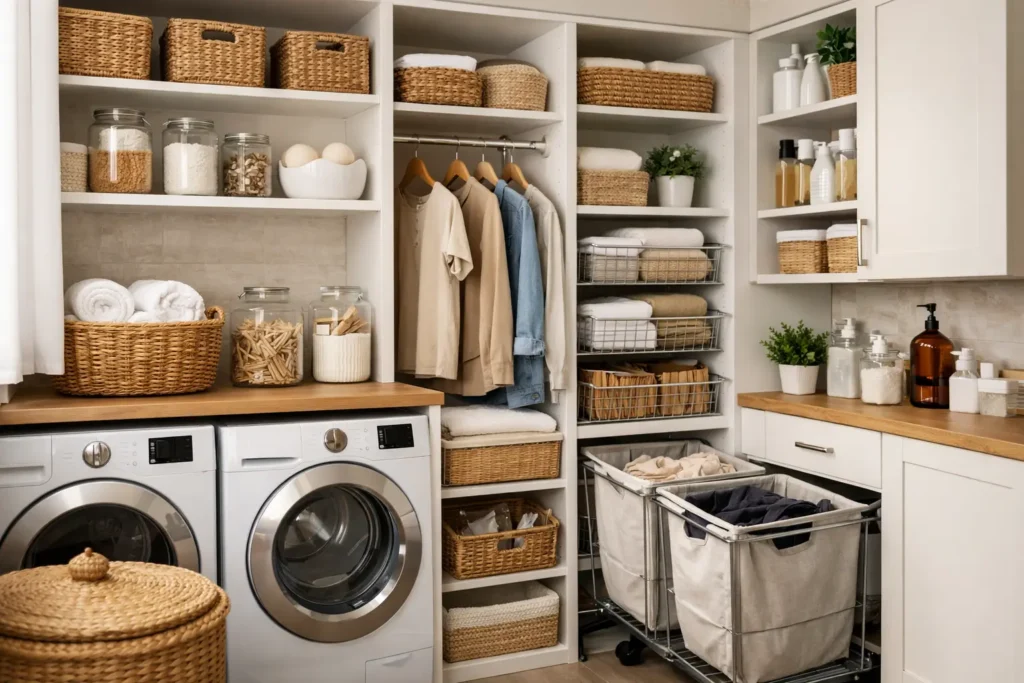

A laundry room can go from mildly annoying to totally chaotic faster than almost any other space in the house. Detergent bottles pile up, lone socks multiply, and suddenly the top of the washer becomes a catchall for everything that does not have a home. The right laundry room storage ideas can change that quickly, even if you are working with a narrow closet, a shared mudroom, or just a tucked-away washer and dryer.
The good news is that you do not need a custom built-in setup to make the space feel better. A few smart choices can help your laundry area look calmer, work harder, and feel more in sync with real life. The best storage solutions are the ones that match how you actually do laundry, not how a picture-perfect room looks online.
Start with the kind of clutter you really have
Before buying bins or baskets, pause and notice what keeps collecting in the room. In some homes, the biggest problem is bulky products like detergent, stain remover, and dryer sheets. In others, it is clean clothes waiting to be folded, pet items, cleaning supplies, or random household overflow.
This matters because good laundry room storage ideas are not one-size-fits-all. If your room is tiny, vertical storage will do more than floor baskets. If kids drop backpacks and shoes near the machines, you may need a hybrid laundry and mudroom setup. If the space is visible from a hallway or kitchen, closed storage may feel calmer than open shelves.
Once you know what needs a home, it gets much easier to organize without wasting money.
Use the wall space you probably are not using
In many laundry rooms, the walls do most of the heavy lifting. That is especially true when the footprint is small.
Add shelves above the washer and dryer
A simple shelf above side-by-side machines can hold detergents, jars of clothespins, extra paper towels, and small baskets for odds and ends. If you like a more styled look, matching containers can make basic supplies feel less busy. If you prefer pure function, sturdy open shelving works just as well.
The trade-off is visibility. Open shelves are easy to grab from, but they also show every bottle and backup item. If visual clutter stresses you out, keep only daily-use items on display and group the rest in lidded bins.
Hang a peg rail or utility hooks
Hooks are one of the easiest upgrades in a laundry space. They give you a place for a lint brush, reusable laundry bags, a drying rack, or items that need to air dry on a hanger. A peg rail also adds a little charm, which can make a hardworking room feel more inviting.
This is a great option for renters too, depending on your wall setup, because it creates storage without taking up floor space.
Install a wall-mounted drying rod
If damp shirts and delicate tops are constantly draped over doors or dining chairs, a drying rod is worth it. Mounted above a counter or near a shelf, it creates a designated zone for hang-drying without making the room feel crowded.
It is a small detail, but it solves one of those daily frustrations that tends to spread mess into the rest of the house.
Choose storage that fits the way you sort laundry
Not everyone sorts clothes the same way, and your storage should reflect that.
Use divided hampers for easy pre-sorting
A divided hamper can save time if you already separate lights, darks, towels, or delicates. It helps reduce those clothing piles on the floor and makes wash day feel less like a full reset.
If you do not sort ahead of time, skip the multi-section hamper and use one large basket instead. There is no reason to buy a system that creates more steps than you want.
Try rolling carts for flexible storage
A slim rolling cart can slide beside the washer or into an awkward gap and hold detergent, dryer balls, stain treatments, and cleaning cloths. It is one of the best laundry room storage ideas for narrow spaces because it uses inches that would otherwise go wasted.
Rolling storage also works well in shared utility rooms, where you may want supplies to be easy to move or tuck away. Just keep weight in mind. Heavy bottles on a flimsy cart can make it wobble fast.
Keep one basket for single socks and small items
It sounds simple because it is. A small labeled bin for single socks, baby items, and loose accessories keeps those tiny pieces from taking over every surface. You can check it once a week instead of feeling like every laundry load comes with a scavenger hunt.
Make hidden spaces work harder
Some of the best storage is the kind that barely shows.
Add cabinets if you want a calmer look
Cabinets instantly make a laundry room feel tidier because they hide visual noise. If your laundry area opens into a kitchen, hallway, or entry, closed storage can make the whole home feel more pulled together.
That said, cabinets are not always the cheapest route. If a full remodel is not in the budget, even one upper cabinet paired with an open shelf can strike a nice balance between function and cost.
Use the back of the door
The back of a laundry room door is often wasted space. Over-the-door organizers can hold smaller items like stain pens, mesh bags, microfiber cloths, and extra sponges. In a tiny laundry closet, this kind of storage can make a big difference without changing the room layout.
Just be realistic about depth. If the door barely clears shelving or machines, a bulky organizer may become more frustrating than helpful.
Tuck baskets under a folding counter
If you have a counter over front-loading machines or a nearby work surface, the space underneath is ideal for baskets. This can be a good place for each family member’s clean laundry, extra towels, or supplies you do not need every day.
Matching baskets look polished, but they do not have to be expensive. Even basic woven or plastic bins can make the room feel much more intentional when they fit the space well.
Turn functional storage into part of the room style
A practical room can still feel warm and pulled together. In fact, when storage looks nice, it is often easier to maintain because the space feels worth keeping up.
Decant the products you use all the time
Pouring detergent, clothespins, or scent beads into simple containers can reduce label overload and make shelves feel less chaotic. This works especially well in open shelving setups where every item stays visible.
There is one caveat here. Convenience matters more than aesthetics. If decanting adds extra effort or makes products harder to identify, skip it. Stylish storage should still be easy to live with.
Label what you can
Labels are not just for pantry fans. In a laundry room, they help everyone in the house know where things go, which makes the system easier to maintain. Bins labeled for pet laundry, cleaning rags, lost socks, and delicates remove guesswork and cut down on clutter.
A label does not need to be fancy to work. Clear and simple is enough.
Mix soft and sturdy textures
Wire baskets, woven bins, wood shelves, and white containers can all work together in a laundry room. Mixing textures helps the room feel less utilitarian and more connected to the rest of your home.
That matters more than people think. A room that feels pleasant tends to get used more carefully, and that usually leads to better habits over time.
Smart laundry room storage ideas for very small spaces
If your laundry setup is in a closet, hallway nook, or apartment corner, focus on compact solutions that do not fight the room.
Stackable machines usually benefit from vertical shelving beside or above them. Wall hooks and collapsible drying racks can handle daily needs without eating up precious floor area. Slim bins are often better than deep ones because you can see what you have without digging.
In very tight spaces, fewer categories often work better too. One bin for supplies, one basket for dirty laundry, and one small tray for daily essentials may be all you need. Over-organizing a tiny room can make it feel more cramped, not less.
Keep the system easy enough to maintain
The most successful laundry rooms are not the ones with the most containers. They are the ones where putting things away feels almost automatic.
Try to keep your most-used products at arm level. Store backups higher up or farther out of the way. Give every recurring item a home, but do not create so many zones that the system becomes hard to follow. If you live with kids or a partner, the best setup is one they can understand at a glance.
That is where a lot of laundry room storage ideas succeed or fail. Pretty matters, but ease matters more. A beautiful shelf arrangement that falls apart in three days is not helping your home.
If you are updating the space little by little, start with the one change that solves your biggest annoyance. Maybe that is a shelf over the machines. Maybe it is a rolling cart, a better hamper, or baskets under the counter. Small fixes count, and they often create the momentum to keep going.
A laundry room does not need to be large or perfectly styled to feel good. It just needs to support the rhythm of your home in a way that feels lighter, calmer, and easier to live with.
Common Laundry Room Storage Mistakes to Avoid
When organizing a laundry room, it is surprisingly easy to create a system that looks great for a week but becomes difficult to maintain over time.
One of the most common mistakes is adding too many containers before identifying what actually needs storage. Bins and baskets can be helpful, but they are not a solution by themselves. If every category gets its own container, the room can become harder to use instead of easier.
Another frequent mistake is prioritizing aesthetics over convenience. Open shelves filled with matching jars may look beautiful, but if detergent refills become inconvenient or family members cannot easily find what they need, the system will not last.
Many homeowners also underestimate the value of vertical storage. In small laundry rooms, wall space is often more useful than additional floor baskets. Shelves, hooks, and drying rods usually provide more storage without making the room feel crowded.
Finally, avoid creating storage systems that only one person understands. The best laundry room organization ideas are simple enough that everyone in the household can maintain them. If putting things away requires too many decisions, clutter tends to return quickly.
A successful laundry room is not the one with the most storage products. It is the one that makes daily routines feel easier and more efficient.
Final Thoughts From Experience
After helping organize and redesign storage solutions in homes of all sizes, one pattern shows up again and again: the best laundry rooms are rarely the most expensive ones.
A well-functioning laundry space is usually the result of a few thoughtful decisions rather than a major renovation. In fact, some of the most effective improvements are surprisingly simple—adding a shelf where products naturally collect, creating a designated spot for lost socks, or using vertical wall space that was previously ignored.
What often causes frustration is not a lack of storage, but a mismatch between the storage system and the way the household actually operates. A family with young children needs different solutions than a couple living in a small apartment. A busy household that does multiple loads per week will benefit from easy-access organization far more than decorative storage that looks good but slows down daily routines.
If you are planning to improve your laundry room, focus first on the friction points you experience every week. Pay attention to where clutter accumulates, which items are hardest to access, and what tasks feel repetitive or inconvenient. Solving those problems will almost always have a bigger impact than buying new organizers simply because they look attractive online.
The laundry rooms that stay organized long-term are usually the ones built around real habits, not idealized ones. When storage supports the natural rhythm of your home, the space becomes easier to maintain, more pleasant to use, and far less likely to turn back into a clutter magnet a few weeks later.
About the Author
Fher is an architect specializing in residential design and space optimization. With hands-on experience improving how homes function and feel, he shares practical insights to help homeowners create spaces that are both beautiful and livable.