
A mantel can make a living room feel finished, even when the rest of the space is still coming together. Learning how to style a mantel is less about buying a cartful of matching decor and more about creating a small, personal scene that feels balanced from across the room and welcoming up close.
The good news is that you do not need a grand fireplace, a huge budget, or a perfectly curated collection. A few well-chosen pieces, some thoughtful layering, and permission to leave a little breathing room can turn an overlooked ledge into a favorite part of your home.
Start With the Mantel’s Job in the Room
Before placing anything, look at what your mantel needs to do visually. In many living rooms, it is the natural focal point. That means it should support the room’s overall style without competing with every other element, from the sofa and rug to the art on nearby walls.
Consider the architecture first. A chunky wood beam mantel often looks best with relaxed, collected pieces such as pottery, framed art, and branches. A traditional painted mantel can handle a more classic arrangement with a mirror, symmetrical sconces, or a pair of matching vases. If your fireplace is small or your room already has a lot going on, keep the mantel simpler. Not every surface needs to tell a big story.
It also helps to think about sightlines. Stand where you usually sit, then take a photo of the empty mantel. Photos make it easier to notice whether the area needs height, warmth, contrast, or a little more color.
How to Style a Mantel With Layers, Not Clutter
The easiest way to make mantel decor look intentional is to work from back to front. Start with one anchor piece, add a few medium-scale items, and finish with smaller accents. This creates depth without the crowded, shelf-like look that can happen when every object is lined up at the same height.
Choose one anchor piece
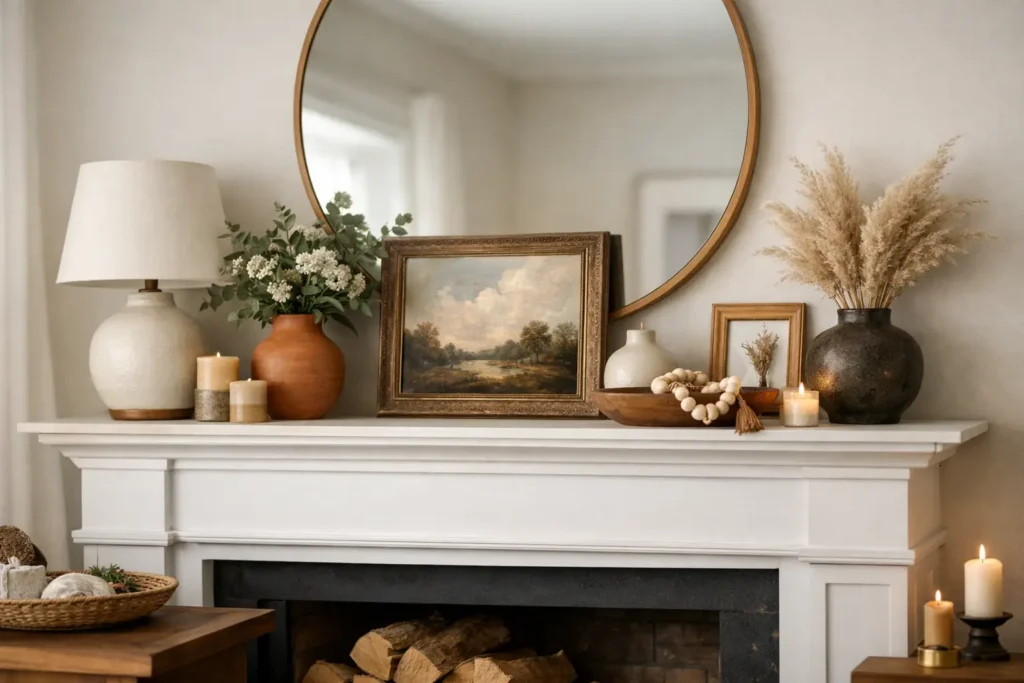
Your anchor is the tallest or most visually substantial item. It might be a mirror, a favorite framed print, an abstract canvas, or even a vintage window frame. For a traditional look, center it above the mantel. For something softer and more relaxed, lean the piece against the wall instead. Leaning art creates instant dimension and is especially helpful for renters or anyone who would rather skip more nail holes.
A mirror can brighten a dim room by reflecting light, but it is not always the best default. If it reflects a television, a busy kitchen, or another visual distraction, art may create a calmer view. Choose the option that gives you something pleasant to look at from the sofa.
Build around it with varied heights
Next, add two or three supporting pieces. A small stack of books, a ceramic vase, a candleholder, or a sculptural object all work well. The goal is variation. If every item is the same height, width, and material, the mantel can feel stiff.
Try a tall vase on one side and a shorter stack of books on the other. Place a small object on the books if the stack needs more presence. This simple move adds height while making everyday items feel considered rather than scattered.
You do not need perfect symmetry. In fact, asymmetry often feels more natural in a real home. The trick is visual balance: one large dark vase on the left might be balanced by a medium frame and a smaller brass object on the right. They do not match, but they carry similar visual weight.
Leave room for the eye to rest
A common mantel-styling mistake is trying to fill every inch. Negative space is part of the design. It lets your favorite pieces stand out and keeps the fireplace from looking busy, especially in a smaller living room.
If you are unsure whether you have added too much, remove one item. Then remove another. The pared-back version is often the one that looks more polished.
Use Color and Texture to Make It Feel Connected
The best mantel decor does not have to match your room exactly, but it should feel related to it. Pull one or two colors from nearby pillows, curtains, artwork, or the rug. A rust-colored vase may echo a throw blanket. A black frame may connect with curtain rods or a floor lamp. These small repeats make the room feel pulled together without looking overly coordinated.
Texture matters just as much as color. A smooth glass vase, weathered wood frame, woven basket, and matte ceramic piece can live together beautifully because each brings a different finish. This is also an easy way to make budget-friendly decor look more layered. A simple thrifted frame feels special next to a handmade-looking bowl or a clipped branch from the yard.
For a cozy look, lean into warm materials such as wood, brass, aged metal, terracotta, and linen-toned art. If your style is more modern, try cleaner shapes with fewer objects, but still include one natural element so the arrangement does not feel cold.
Add Something Living or Personal
A mantel looks most inviting when it includes at least one thing that feels alive or meaningful. Fresh greenery, faux stems, dried grasses, or a leafy branch can soften hard lines and add height without much expense. Use a vessel that is substantial enough to hold its own, especially if your mantel is wide.
Personal pieces are equally powerful. A small family photo, a travel memento, a handmade ceramic bowl, or a book you actually love brings character that no store display can duplicate. You do not need to display everything you own. One personal detail among more neutral decor is often enough to make the whole arrangement feel like yours.
If your mantel sits directly above a working fireplace, keep heat and soot in mind. Avoid placing delicate photos, wax candles, dried florals, or anything combustible too close to the firebox. Follow your fireplace manufacturer’s clearance guidance, and save more delicate displays for months when the fireplace is not in use.
A Simple Formula for Different Mantel Sizes
There is no single correct arrangement, but scale makes a big difference. A narrow mantel needs fewer, slimmer items, while a long mantel needs enough presence to avoid looking empty in the middle.
For a small mantel, choose one medium-sized frame or mirror, one vase with stems, and one low accent such as a candleholder or small bowl. Keep the palette quiet and avoid several tiny objects that can read as clutter.
For a standard-width mantel, use a large central anchor and build an uneven grouping on either side. You might place a tall vase and books on one end, then a smaller frame and decorative object on the other. Let the center remain somewhat open so the anchor still leads.
For a long mantel, create two or three loose groupings rather than spreading objects evenly from end to end. Repeating a material, such as two ceramic vessels or a pair of brass candlesticks, can give the whole display rhythm without making it look overly formal.
Refresh It Seasonally Without Starting Over
Seasonal styling is one of the easiest ways to make your home feel cared for, but it does not require a complete decor swap. Keep your anchor piece and core objects in place, then change one or two details.
In spring, add fresh green stems or a lighter art print. Summer calls for airy branches, woven texture, or a bowl of collected shells if that suits your style. In fall, bring in warmer pottery, muted foliage, or taper candles. Winter may be the time for evergreen clippings, soft lights, and a more layered look.
The goal is not to make your mantel look like a holiday aisle. A few seasonal touches will feel more timeless and leave room for the pieces that tell your story year-round.
Mantel Styling Mistakes That Are Easy to Fix
When a mantel feels off, the issue is usually scale or sameness. A tiny mirror above a wide fireplace can disappear, while a collection of objects all in the same neutral finish can feel flat. Add contrast through height, texture, or one deeper color before buying more decor.
Another common issue is treating both sides as identical when the room itself is relaxed and casual. Symmetry can be beautiful, particularly in formal spaces, but it is not a rule. Choose symmetry if you love order and your fireplace has a classic shape. Choose asymmetry if you prefer a collected, lived-in feeling.
Finally, do not style from a single close-up angle. Step back regularly. Your mantel is part of the room, and it should look good from the chair where you drink coffee, the hallway where you first see it, and the spot where friends gather.
Your mantel does not need to look finished forever. Let it change as your seasons, routines, and favorite finds change. The most welcoming version will always be the one that feels at home with the people living around it.
Final Thoughts From Experience
After styling and looking at enough living rooms, I’ve found that the best mantels are rarely the ones with the most decoration. They are the ones where the scale feels right, the materials relate to the room, and nothing looks as though it was placed there simply to fill an empty spot.
One of the easiest mistakes to make is shopping for mantel decor before looking at the room. A beautiful vase or mirror can still be the wrong choice if it is too small for the fireplace, competes with the television, or introduces a color that has nowhere else to go. I always recommend starting with what is already working in the room and then choosing pieces that support it.
I also think it is worth resisting the temptation to make both sides of the mantel perfectly symmetrical. Symmetry has its place, especially in more traditional rooms, but balance does not require matching. A taller object on one side can work beautifully with several smaller pieces on the other when their overall visual weight feels comparable.
Before considering the mantel finished, step back and look at it from the places where you actually use the room. If something immediately feels too small, too crowded, too dark, or simply distracting, trust that reaction. Move one piece, remove another, and look again. Sometimes the best styling decision is not adding something new but giving the pieces you already love more room to breathe.
That is ultimately what makes a mantel feel like home. It should have enough structure to look intentional, but enough personality to feel lived in. Start with the architecture, pay attention to scale, layer with purpose, and leave a little space for the things you will find and love later.
About the Author
Fher is an architect specializing in residential design and space optimization. With hands-on experience improving how homes function and feel, he shares practical insights to help homeowners create spaces that are both beautiful and livable.