
A coffee table has a tough job in a real living room. It catches remotes, holds Saturday morning coffee, gives kids a place to build a puzzle, and still needs to make the sofa area feel pulled together. Learning how to style a coffee table is less about arranging expensive objects and more about creating a small, flexible display that works for the way your household actually lives.
The best coffee table styling looks relaxed rather than overly arranged. A few thoughtful layers can make even a basic table feel intentional, but there should still be room to set down a drink, prop up your feet, or clear the surface in seconds when company arrives.
Start With How You Use the Table
Before choosing decor, think about what your coffee table does every day. A formal living room that is mostly used for guests can handle a fuller arrangement than a family room where snacks, board games, and movie nights happen regularly. There is no benefit to a beautiful setup that feels like an obstacle course by Tuesday.
Give yourself permission to style less if your table works hard. One tray, a small stack of books, and a low vase may be all you need. If the table is more decorative than functional, you can add a few more layers and let the arrangement become a stronger focal point.
Clear the visual clutter first
Start with a completely empty table. This makes it easier to see its shape, finish, and size, rather than trying to decorate around stray chargers and old mail. Keep everyday necessities nearby in a basket, drawer, or lidded box instead of letting them become part of the display.
Also consider the table itself. A rustic wood table often looks best with a lighter touch because the grain and texture already add interest. A simple glass, white, or lacquered table may benefit from warmer materials such as woven trays, ceramic pieces, and stacked books.
How to Style a Coffee Table in Easy Layers
A polished coffee table usually includes a mix of useful, natural, personal, and decorative elements. The goal is variety, not perfection. Pair smooth with textured, tall with low, and practical with pretty so the arrangement has depth without looking busy.
A simple formula to keep in mind is:
- A grounding piece, such as a tray or stack of books
- Something living, like flowers, greenery, or a small plant
- One sculptural or textured accent
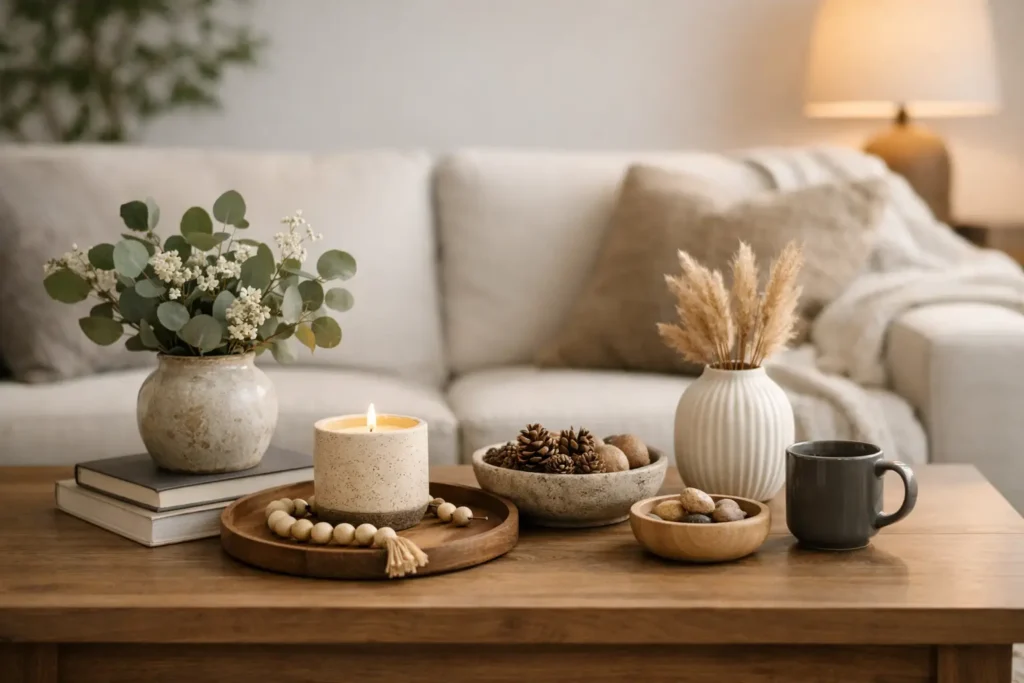
- A practical item, such as a candle, coaster set, or decorative box
You do not need every category on every table. These are building blocks, not rules. A compact apartment coffee table might only need two or three pieces, while a large square table can comfortably hold several small groupings.
Use a tray to create order
A tray is one of the easiest ways to make coffee table decor feel organized. It visually gathers smaller items so they read as a deliberate arrangement instead of random objects. It also makes cleanup simple: when you need more room, lift the tray and move it aside.
Choose a tray that contrasts gently with the tabletop. A woven tray brings softness to metal or glass. A wood, marble-look, or dark lacquer tray can add structure to an upholstered ottoman used as a table. Round trays soften square tables, while rectangular trays work especially well on long tables.
Inside the tray, keep the grouping low enough that it does not block conversation across the room. A candle, a small bud vase, a pretty match holder, and a tiny bowl for stray items can look cozy and useful without taking over the surface.
Build height, but keep sightlines open
Coffee table styling needs variation in height, but towering arrangements can feel awkward. Generally, the tallest pieces should stay below eye level when you are seated. Low floral arrangements, short branches, candles, and stacked books make the room feel inviting because you can still see the people across from you.
Books are especially helpful because they add height gradually. Stack two or three large, attractive books and top them with a small object, such as a ceramic bowl, a candle, or a wooden bead strand. Choose titles that reflect your interests, whether that means gardening, travel, cooking, fashion, or local history. They make the table feel personal in a quiet, natural way.
If you want flowers, use a small vase rather than a large bouquet. Fresh stems instantly brighten a room, but a simple branch clipped from the yard or a realistic faux stem can create the same relaxed effect with less maintenance.
Match the Arrangement to Your Table Shape
The shape of your coffee table gives you a helpful starting point. Trying to force one arrangement onto every table is a common reason decor ends up looking crowded or off-balance.
Round coffee tables
Round tables tend to look best with a centered arrangement. Start with a round tray, a low plant, or a small cluster of three objects. Avoid lining items up along the edge, which can make the table feel smaller and less natural.
Rectangular coffee tables
A long table usually needs more than one moment of interest. Think in two or three loose zones rather than filling the middle with one large item. For example, place a tray on one side, a book stack near the center, and a low bowl or plant at the other end. Leave some open space between each group so the surface can breathe.
Square coffee tables
Square tables often have enough room for a grid-like layout. Divide the surface visually into four sections, then place a different low grouping in each area. You might use a tray, a stack of books, a plant, and a decorative bowl. The groupings do not need to match, but they should share a color, material, or overall mood.
Ottoman coffee tables
An upholstered ottoman needs a firm base before it can function as a coffee table. A large tray gives you that stable surface while also protecting the fabric from drips and candle wax. Keep the decor lightweight and easy to move, since an ottoman is often used for extra seating or a place to put up your feet.
Add Personality Without Adding Clutter
The coffee table is a wonderful place to show a little of who lives in the home. The key is choosing a few items with meaning instead of displaying every pretty object you own. A handmade bowl from a trip, a vintage brass dish from a relative, or a favorite candle scent can make the room feel far more lived-in than generic decor ever could.
Color can help tie the arrangement to the rest of the room. Pull one or two shades from your pillows, rug, or artwork and repeat them subtly through book covers, flowers, or ceramics. You do not need an exact match. Soft echoes of color are enough to make the room feel connected.
Texture is just as useful, especially in neutral spaces. Try combining a woven tray with a glossy ceramic vase, a matte stone coaster, and linen-covered books. That mix adds warmth even when the palette stays calm and simple.
Common Coffee Table Styling Mistakes to Skip
The most common mistake is filling every inch of the surface. Empty space is not unfinished space. It gives your favorite pieces room to stand out and makes the table useful when real life happens.
Another mistake is using decor that is all the same height. A flat row of candles or small objects can look more like a store shelf than part of a welcoming home. Vary the heights gently with books, a vase, or a small sculptural piece.
Finally, do not forget scale. Tiny accessories can disappear on a large sectional-sized coffee table, while an oversized tray can overwhelm a petite apartment table. If the setup looks slightly off, remove one item before buying more. Editing is often the easiest fix.
Refresh It With the Seasons, Not Every Week
You do not need to restyle your coffee table constantly to keep it feeling fresh. Keep a few reliable basics in place, then make small seasonal changes when the mood strikes. In spring, add fresh greenery or a lighter ceramic vase. In fall, bring in warmer woods, amber glass, or a softly scented candle. During the holidays, a small bowl of ornaments or a clipped evergreen branch can feel festive without taking over the room.
Your coffee table does not need to look like a showroom to make an impact. When it holds a few things you love, leaves room for the life happening around it, and makes you happy when you walk into the room, it is styled exactly as it should be.
The Professional Styling Test: Sit Down Before You Add More
There is one simple test I like to use when a coffee table arrangement does not quite feel right: stop standing over the table and sit down on the sofa.
Look at the arrangement from the same height you will see it every day. A vase that looked perfectly proportioned while you were standing may suddenly feel too tall. A decorative bowl that seemed interesting from above may disappear completely from the seating area. You may also notice that several objects are blocking the visual connection between the sofa and the chairs opposite it.
This is especially important in open-concept living rooms, where the coffee table is often visible from several seating areas.
From the sofa, check three things.
First, make sure the tallest object does not interrupt conversation or block an important view across the room.
Second, look at the amount of negative space around the objects. If everything is pushed toward the edges or packed into the center, remove one piece and look again.
Finally, think about what happens when you actually use the table. If you regularly drink coffee there, leave a convenient place for a mug. If your family plays games in the living room, make sure the arrangement can be cleared quickly. If the table doubles as an ottoman, keep the styling light and easy to move.
A coffee table arrangement is successful when it looks intentional from the sofa and still works when real life takes over.
Final Thoughts From Experience
When styling a coffee table, I have found that the best results usually come from editing rather than adding more. It is easy to look at an empty table and think it needs another candle, another stack of books, or one more decorative object. Most of the time, it needs the opposite.
Start with the pieces that genuinely belong in your room. A favorite book, a bowl you picked up while traveling, a small plant, or a tray you use every day will usually make the arrangement feel more personal than a collection of perfectly coordinated accessories.
Then test the setup from the way you actually use the room. Sit on the sofa. Look across the table. Can you see the people sitting opposite you? Is there enough space to put down a coffee cup? Can you move the tray easily when you need the entire surface for snacks, a game, or a family gathering?
That simple test catches problems that are easy to miss when you are standing over the table arranging everything.
I also would not worry too much about following a decorating formula exactly. Formulas are useful when you are starting, but they should help you make decisions rather than dictate the final result. If your table looks better with two larger objects instead of five small ones, trust what you are seeing. If the tabletop has beautiful wood grain, leaving part of it uncovered may be more effective than decorating every section.
One mistake I see often is trying to make a coffee table look finished from every angle. A living room is not a photograph. People will move things, put down drinks, leave a remote on the table, and occasionally clear everything away. Good styling should be flexible enough to survive that.
For that reason, I would prioritize three things above all else: proportion, usability, and personality. Get the scale right, leave enough open space for everyday life, and choose at least one or two pieces that actually mean something to you.
That is what makes a coffee table feel like part of a home rather than a display. The goal is not to create a perfect arrangement that nobody is allowed to touch. It is to create a small, welcoming part of the room that looks good, works well, and still feels natural after real life happens.
About the Author
Fher is an architect specializing in residential design and space optimization. With hands-on experience improving how homes function and feel, he shares practical insights to help homeowners create spaces that are both beautiful and livable.