
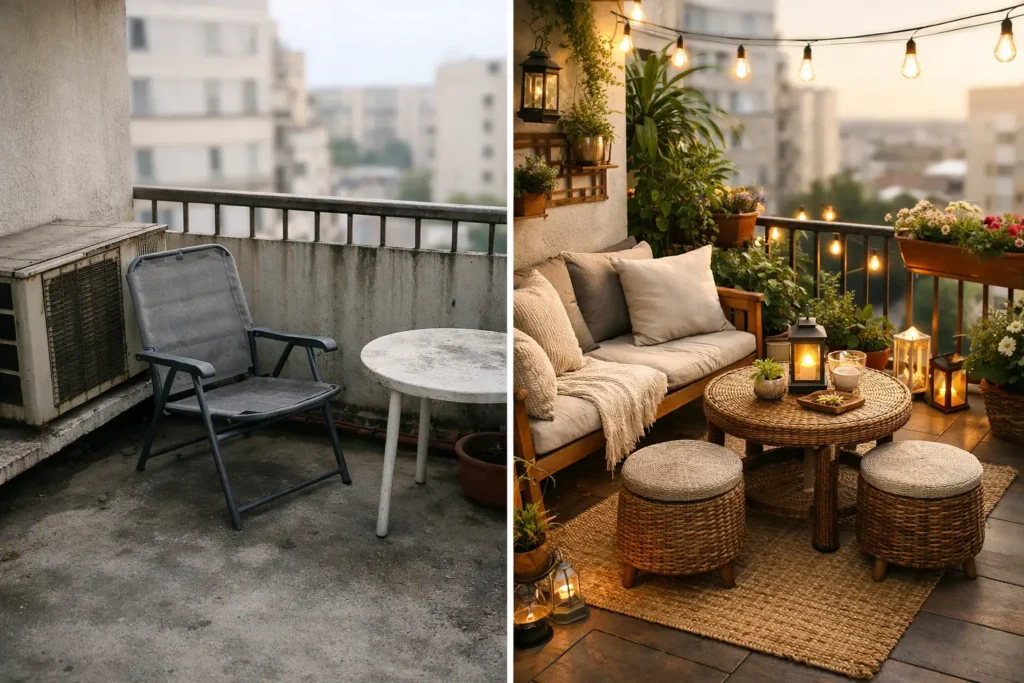

A great small balcony makeover before and after rarely starts with buying more. It starts with noticing what is getting in the way: a bare concrete floor, a few forgotten chairs, no privacy, or a layout that makes the space feel more like a storage ledge than somewhere you would actually linger. Even a balcony only wide enough for two chairs can become a favorite part of your home when every choice has a purpose.
The goal is not to recreate a magazine terrace. It is to create an outdoor spot that fits your real life, whether that means a quiet morning coffee, a place to grow herbs, or a cozy corner to catch up with a friend after dinner.
Start With What the Balcony Needs to Do
Before you choose a rug or string lights, decide how you want to use the space most often. This one decision keeps a tiny balcony from becoming crowded with pretty things that never earn their square footage.
If you want a dining spot, prioritize a narrow bistro table and chairs that tuck in. If you picture reading outside, a comfortable lounge chair and a small side table matter more. For plant lovers, vertical growing space may be the main event. A balcony can do more than one job, but it usually works best when one use leads and the others support it.
Also take a practical look at the conditions. Notice where the sun lands, how much rain reaches the floor, and whether wind tends to knock over lightweight decor. Check your lease, condo rules, or building guidelines before adding privacy screens, hanging planters, outdoor rugs, or anything attached to the railing. The most beautiful setup is not much use if it is difficult to maintain or breaks a building rule.
The Before: Why Small Balconies Feel Unfinished
Most underused balconies have the same handful of problems. The floor feels cold and temporary, the railing leaves you exposed, and furniture is either too bulky or too sparse. Because the area is visible from indoors, a cluttered balcony can also make the room behind it feel less polished.
The good news is that these issues are connected. Address the floor, seating, and vertical boundaries, and the entire view changes quickly. That is why balcony makeovers can feel so satisfying: a few smart layers create a dramatic difference without requiring a major renovation.
Clear the Floor Before You Style It
Remove anything that does not belong outside or does not support your plan for the space. Broken pots, empty boxes, drying racks, and extra furniture quietly steal visual breathing room. Be honest about what you use.
Then clean thoroughly. Sweep corners, wipe down the railing, and scrub any grime from the floor. This simple reset makes every upgrade look better, and it costs almost nothing. If the concrete is stained, weathered, or simply unattractive, a weather-resistant outdoor rug or interlocking deck tiles can create the biggest immediate visual shift.
Deck tiles give a warm, finished look, especially in a rental where permanent changes are off the table. They do require regular cleaning underneath, though, and some balconies need drainage to stay clear. An outdoor rug is lighter, less expensive, and easy to swap, but it may need time to dry after heavy rain. Choose based on your climate and how hands-on you want maintenance to be.
Small Balcony Makeover Before and After: Build From the Ground Up
Once the floor has a little warmth, add furniture in the right scale. Small-space decorating is not about buying the smallest version of everything. It is about choosing pieces with a clear function and an airy footprint.
Look for open-frame chairs, slim legs, folding designs, or benches that can slide under a table. A petite bistro set is a classic choice because it gives you a place to sit, eat, and set down a drink without taking over the entire balcony. If a full table feels tight, use a weatherproof stool or garden seat as a side table instead.
For a long, narrow balcony, place furniture along one side rather than centering it. Leaving a clear path from the door to the railing makes the space feel calmer and safer to use. On a square balcony, try positioning two chairs at a slight angle with a tiny table between them. The arrangement feels intentional, even when the footprint is modest.
Add Comfort in Outdoor-Friendly Layers
A balcony should invite you to stay longer than five minutes. Seat cushions, washable pillow covers, and a lightweight throw for cool evenings bring that living-room feeling outside. Stick to two or three colors so the small area does not become visually busy.
A simple palette often works best: warm neutrals with green plants, soft blue with natural wood, or terracotta accents with cream and black. You do not need every item to match. Repeating one color in a cushion, planter, and rug creates enough connection to make the setting feel pulled together.
Choose fabrics labeled for outdoor use when the balcony is exposed to rain and strong sun. If yours is covered, you have more flexibility, but it is still wise to bring soft textiles inside during wet weather. The trade-off is worth considering. Indoor pillows can look wonderfully cozy, but replacing faded or soggy fabric is not particularly budget-friendly.
Use Height for Plants and Privacy
When floor space is limited, the railing and walls become valuable decorating real estate. Plants soften hard edges, improve the view from inside, and make even a city-facing balcony feel more private. The trick is to use height without blocking light or making the area hard to navigate.
Try railing planters for trailing greenery, a narrow plant stand in an unused corner, or a vertical trellis with climbing plants if your building permits it. For beginners, choose varieties that match the balcony’s light rather than forcing a full-sun plant into shade. Herbs can be especially rewarding near a kitchen, but they need enough direct light to thrive.
Privacy is another common before-and-after turning point. Outdoor curtains, a freestanding screen, reed fencing, or a tall planter can create a more sheltered feeling. Each option has a different look and level of commitment. Curtains feel soft and romantic but need to be secured in wind. Screening offers more coverage but can make a small balcony feel enclosed if it is too solid or too tall.
If privacy is not the issue, use one vertical focal point instead. A small outdoor-safe wall feature, a grouped collection of planters, or a string of warm lights gives the eye somewhere to land after dark.
Let Lighting Make the After Feel Special
Good lighting is what turns a styled balcony into a place you actually use at night. Skip anything overly bright or harsh. Warm white string lights, a compact lantern, or battery-operated table lamps create a softer glow and are usually renter-friendly.
Keep safety front and center. Use lighting rated for outdoor use, avoid running cords across walking paths, and follow your building’s rules around outlets and hanging fixtures. Solar lights can be convenient, although they need enough sunlight during the day to perform well after sunset. A shaded north-facing balcony may be better served by rechargeable lights.
You do not need to decorate every inch. In fact, the strongest after photos usually have a little empty space. One comfortable seat, a place for a drink, a few healthy plants, and gentle lighting can be more appealing than a balcony packed with decor.
Make It Easy to Keep Beautiful
The difference between a lovely weekend project and a lasting transformation is upkeep. Choose planters with saucers or proper drainage, store cushions in a weatherproof bin when storms roll in, and give the floor a quick sweep each week. A small tray can corral candles, drinks, or gardening tools so the table stays useful instead of becoming a catchall.
Refresh seasonally rather than starting over. In summer, add bright pillows and herbs. In fall, bring in a cozier throw and a few textured accents. When winter weather arrives, pare the space back to the durable pieces and enjoy the view from inside. Your balcony does not have to look the same all year to feel cared for.
The best before-and-after result is not the one with the most decor. It is the one that makes you open the door more often. Start with one practical improvement, add the layers that make you happy, and let your little outdoor space become part of the home you love.
The 3 Things I Prioritize First
When a small balcony needs a makeover, I would not try to change everything at once. The limited space means a few decisions will have much more impact than a long list of decorative accessories. These are the three areas I would prioritize first.
1. The Floor
The floor is one of the largest visual surfaces on a small balcony, so changing it can make the space feel different almost immediately. If the concrete looks cold or worn, an outdoor rug or interlocking deck tiles can add warmth and make the balcony feel more intentional.
I would choose the option based on the balcony’s exposure to rain and the amount of maintenance you are willing to handle. There is no point choosing a beautiful floor covering that constantly stays damp or becomes difficult to clean.
2. Furniture and Layout
Next, I would focus on how the furniture fits and how easily you can move around it. In a small balcony, oversized furniture can make the entire space feel cramped, even when there are only two or three pieces.
Look for furniture that serves a clear purpose and, whenever possible, can fold, stack, tuck away, or serve more than one function. I also like to leave a simple walking path from the door. That small detail can make a surprisingly big difference in how comfortable the balcony feels.
3. Privacy and Vertical Space
Once the floor and furniture are working, I would look upward. Walls, railings, and corners can provide valuable space for plants, lighting, or privacy without taking over the floor.
A few strategically placed plants, a narrow trellis, or a lightweight privacy screen can change the feeling of the balcony considerably. The key is restraint. If you cover every available surface, a small balcony can quickly feel enclosed instead of cozy.
If your budget is limited, I would rather invest in these three areas than fill the balcony with small decorative pieces. A better floor, properly scaled furniture, and one thoughtful vertical element usually create a stronger before-and-after effect than a collection of accessories.
Final Thoughts From Experience
One thing I have learned from working through small-space decorating decisions is that the best balcony makeovers are rarely the ones with the most furniture or the most decoration. They are the ones where the space has been edited carefully.
When a balcony feels too small, my first instinct is not to add another piece. I look at what can be removed, what is taking up valuable floor space, and what the balcony is actually missing. Sometimes the biggest improvement is simply replacing an oversized chair with a slimmer one or moving furniture to create a clear path.
I also think it is worth spending more time on the practical details than you might expect. Before buying an outdoor rug, for example, consider how quickly it will dry after rain. Before adding curtains or a privacy screen, think about wind. Before filling the balcony with plants, check how much direct sunlight the space really receives. These decisions may not be as exciting as choosing cushions or string lights, but they are what determine whether the makeover still works a few months later.
If you are working with a limited budget, I would tackle the balcony in stages. Start by cleaning and clearing the space. Then improve the floor or seating, depending on which one is causing the biggest problem. After that, add plants, privacy, and lighting as the budget allows. There is no need to finish everything in one weekend.
Most importantly, leave some breathing room. A small balcony does not need to look full to look finished. A comfortable chair, a small surface for your coffee, a few well-placed plants, and good evening light can be enough.
The real before-and-after is not just what the balcony looks like in a photo. It is whether you find yourself opening the door and using it more often. That is usually the best sign that the makeover worked.
About the Author
Fher is an architect specializing in residential design and space optimization. With hands-on experience improving how homes function and feel, he shares practical insights to help homeowners create spaces that are both beautiful and livable.