
A dining room can have a beautiful table, favorite chairs, and a carefully chosen rug, yet still feel a little flat once the sun goes down. The missing piece is often the light overhead. This guide to choosing dining room lighting will help you create a space that works for weeknight dinners, homework sessions, holiday meals, and the slow Sunday brunches that make a house feel like home.
The goal is not to make your dining room look like a showroom. It is to choose lighting that feels inviting, gives everyone enough light to see their plate, and suits the way your household actually gathers. A single well-chosen fixture can make a surprisingly big difference, even in a rental or a small dining nook.
Start With How Your Dining Room Is Used
Before falling in love with a chandelier, think about what happens at your table. Is it used mainly for dinner? Does it double as a work surface, a place for school projects, or the landing zone for mail? A formal-looking fixture may be perfect for a dedicated dining room, while a more flexible setup can be better for a busy open-plan kitchen and dining area.
If your family spends long stretches at the table, prioritize comfortable, evenly spread light. A dimmer is especially helpful here. It lets you brighten the room for practical tasks, then soften the mood when dinner is served. Dimmers are a small upgrade with a very noticeable payoff, although installation may require an electrician if your wiring is older or you are not comfortable changing switches.
Also consider sightlines. In an open floor plan, your dining fixture is visible from the kitchen and living room, so its style needs to relate to the rest of the space. It does not have to match every finish exactly. A black pendant can still work near brass kitchen hardware, for example, if both choices feel intentional and repeat elsewhere in small ways.
Choose the Right Fixture Size
A fixture that is too small can disappear above a large table. One that is too wide can make the room feel crowded and block conversation. Luckily, a simple measurement gives you a reliable starting point.
Add the length and width of your dining room in feet, then use that number in inches as a rough guide for fixture diameter. For example, a room that measures 10 by 12 feet can usually handle a fixture around 22 inches wide. This is a guideline, not a rule written in stone. In a compact room with a substantial table, sizing based on the table often makes more sense.
For a round chandelier or pendant, aim for a fixture about one-half to two-thirds the width of the table. A 42-inch round table, for instance, usually looks balanced with a light around 21 to 28 inches wide. Keep at least 6 inches of space from each edge of the fixture to the table edge, and more if your room allows it.
Long rectangular tables often look best with an elongated linear chandelier, a lantern-style fixture, or a row of two or three pendants. The lighting should visually follow the table rather than float as a tiny dot in the middle. For very long tables, two matching fixtures can look more balanced than one oversized piece.
Small dining rooms need visual breathing room
In a small apartment dining area, scale matters even more. Choose a fixture with an open frame, clear glass, or a slim profile to keep the ceiling from feeling low and heavy. A single pendant with a broad shade can work beautifully over a small round table, while a flush-mount fixture may be the smartest option if ceilings are under 8 feet.
Do not assume a small room requires a boring light. A sculptural semi-flush fixture, woven pendant, or compact lantern can add personality without taking over your cozy corner.
Hang Dining Room Lighting at a Comfortable Height
The standard hanging height for a chandelier or pendant over a dining table is 30 to 36 inches above the tabletop. That range generally keeps the fixture low enough to feel connected to the table but high enough that guests can see one another across it.
Use the lower end of the range for an 8-foot ceiling and move upward as ceiling height increases. For every additional foot of ceiling height, add about 3 inches to the hanging height. If you have a 10-foot ceiling, a fixture may look better about 36 to 42 inches over the table.
These numbers are useful, but always test them in real life. Have someone hold the fixture or use painter’s tape and string to mark its lowest point before installation. Sit in each chair. If the light interrupts the view of the person across from you, it is too low. If it seems disconnected from the table, it may be too high.
Center the fixture over the table, not automatically in the center of the room. This is particularly important in dining rooms with off-center windows, built-ins, or furniture arrangements. Your table is the destination, and the light should anchor it.
Pick a Bulb Color That Feels Welcoming
The fixture gets much of the attention, but the bulb determines how the room actually feels at night. For most dining rooms, warm white bulbs in the 2700K to 3000K range are the sweet spot. They create a soft, flattering glow that works well with wood tones, painted walls, and food on the table.
Cooler bulbs can make a dining room feel stark or bluish, especially when paired with gray walls or bright white finishes. They are not always wrong, but they tend to suit task-focused spaces better than a room meant for lingering over a meal.
LED bulbs are the practical choice for most households because they use less energy and last longer. Look for dimmable LEDs if you plan to use a dimmer, and check that the switch and bulbs are compatible. Incompatible parts can cause flickering or buzzing, which is a quick way to ruin an otherwise lovely setup.
Brightness depends on the fixture, shade, and room size, but dining rooms rarely need harsh overhead light. If your fixture takes several bulbs, choose lower-lumen bulbs and let the dimmer do the work. If it has a dark metal or opaque shade that directs light downward, add another source of ambient light nearby.
Layer Light Beyond the Table
A beautiful chandelier alone does not always light the whole room well. Layering is what makes a dining room feel warm rather than shadowy. Your overhead fixture provides the focus, while supporting lighting fills in the edges.
A sideboard is an easy place to add a small table lamp, especially in a room without much natural light. Pair it with a mirror, artwork, or a few favorite serving pieces for an arrangement that feels lived-in rather than overly styled. Wall sconces can also add a lovely glow, though they are more of a commitment and may require electrical work.
In a rental, plug-in sconces, cordless lamps, or a small lamp on a buffet can give you some of the same cozy effect without opening up the walls. These choices are especially useful when the ceiling fixture is limited by what your landlord allows.
Let the Fixture Support Your Style
Dining room lighting is a chance to add contrast and character. If your room has a simple wood table and neutral chairs, a more expressive fixture can become the focal point. If your wallpaper, rug, or art is already busy, a classic shape in a quiet finish may give the room needed balance.
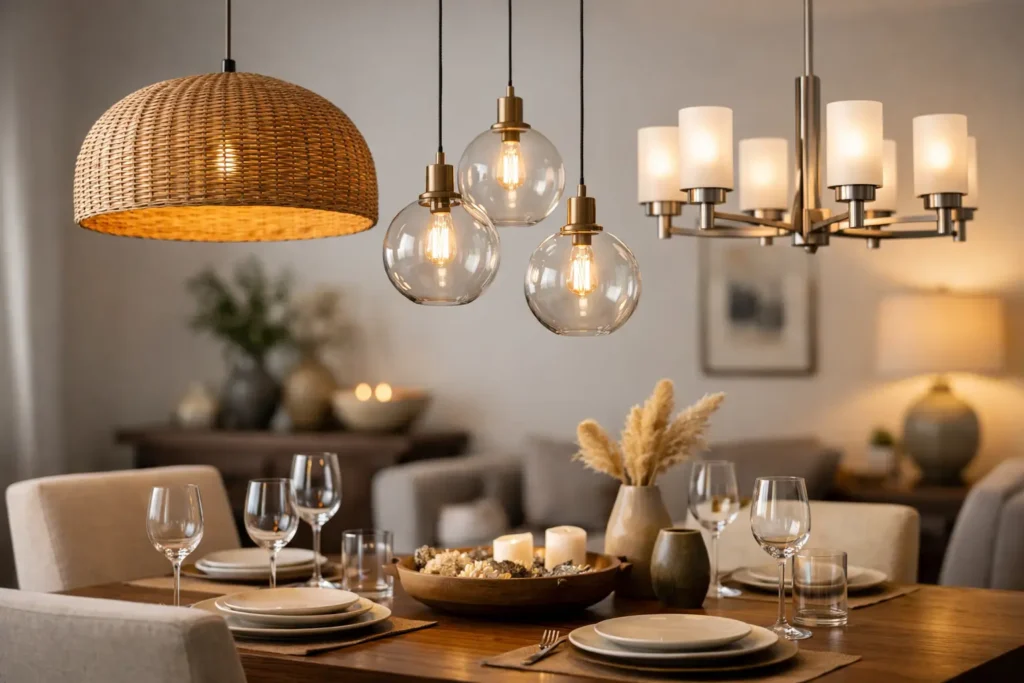
Woven rattan and natural fiber shades bring softness to casual, coastal, and organic spaces, but they can cast patterned shadows. Brass and aged bronze feel warm and timeless, though polished finishes show fingerprints more easily. Black metal creates definition in modern farmhouse, industrial, and contemporary rooms, but it can look heavy in a small room unless the shape is open.
Glass fixtures offer lightness and versatility, yet clear glass also makes bulbs fully visible. Choose attractive bulbs, such as warm globe bulbs or soft white LED filaments, if they will be part of the look. Fabric shades diffuse glare beautifully, but they can collect dust and may not be ideal near a table where candles, food, and busy family life are part of the routine.
Common Dining Room Lighting Mistakes to Avoid
The biggest mistake is choosing a fixture only from a product photo. Measure your room, table, and ceiling height before ordering. A fixture can look charming online but feel undersized once it is placed above a table that seats six.
Another common issue is relying on one overly bright overhead source. Even a budget-friendly room feels more polished when you can lower the overhead light and turn on a lamp nearby. Finally, do not forget the table itself. If your table is regularly extended for guests, plan lighting around its largest everyday configuration or choose a fixture that still looks balanced when the leaves are in.
The best dining room light is the one that makes people want to stay at the table a little longer. Start with the right scale, add a warm dimmable glow, and choose a style that feels like it belongs in your real life. That is how an everyday meal gets a setting worth savoring.
A Practical Dining Room Lighting Checklist
Before buying a dining room chandelier or pendant, take a few minutes to check the basics. It can save you from an expensive fixture that looks great online but does not work well in your space.
Start with the table. Measure its length and width, and consider whether it is regularly extended when you have guests. The fixture should feel proportional to the table in its most common configuration.
Next, measure the ceiling height and decide where the bottom of the fixture should sit above the tabletop. For most dining rooms, 30 to 36 inches is a useful starting point, but the final height should also take sightlines and the scale of the fixture into account.
Then look at the light itself. A fixture with a dark or opaque shade may concentrate light downward, while clear glass or an open frame can spread light more freely. If the fixture does not provide enough ambient light, plan for a second source such as a table lamp, wall sconce, or nearby floor lamp.
Before ordering, check these five things:
- Table size: Is the fixture proportional to the table?
- Ceiling height: Will there be enough clearance above the tabletop?
- Bulb type: Are the bulbs warm, dimmable, and compatible with the fixture and switch?
- Light distribution: Will the fixture illuminate more than just the center of the table?
- Installation: Does the existing electrical box support the fixture, and will professional installation be needed?
One final step is easy to overlook: look at the fixture from the seated position. Dining room lighting is experienced mostly while sitting at the table, not while standing underneath it. A fixture that looks perfect from across the room may feel too low, too bright, or visually distracting once everyone is seated.
Taking these few measurements before shopping makes the decision much easier and helps you choose a fixture based on how the room actually functions, rather than simply how it looks in a product photo.
Final Thoughts From Experience
Good dining room lighting is less about finding the most impressive chandelier and more about getting several small decisions right. The size needs to relate to the table, the height needs to work with the room and your sightlines, and the light itself needs to feel comfortable once the sun goes down.
If you are unsure where to start, I would prioritize function first and style second. Choose the fixture size and placement based on your table, decide how much flexibility you need from the lighting, and then narrow down the finishes and shapes that fit your decor. This approach usually produces a more cohesive result than starting with a fixture simply because you love its appearance.
I would also avoid trying to solve every lighting problem with the ceiling fixture. A dining room tends to feel much more comfortable when the overhead light can be dimmed and another, softer source can be switched on nearby. Even a small lamp on a sideboard can change the atmosphere without requiring a major renovation.
And remember that the “right” dining room lighting will depend on the way you actually use the space. A formal dining room that is mainly used for entertaining can handle a more decorative statement fixture. A dining table that also serves as a homework station or home office needs more flexibility. A small apartment may benefit more from a compact pendant or semi-flush fixture than a large chandelier.
Before making a purchase, measure the room, measure the table, check the ceiling height, and think about what happens at the table after dark. Those few minutes of planning can make the difference between lighting that simply fills a room and lighting that makes the room feel inviting.
The best dining room lighting does not compete with the people sitting around the table. It quietly supports the room, makes everyday meals more comfortable, and gives special occasions the atmosphere they deserve.
About the Author
Fher is an architect specializing in residential design and space optimization. With hands-on experience improving how homes function and feel, he shares practical insights to help homeowners create spaces that are both beautiful and livable.