
When your bed, sofa, desk, and dining table all live in one room, clutter shows up fast. The best storage ideas for studio apartments are the ones that work quietly in the background, helping your space feel lighter, calmer, and much easier to live in.
A good studio does not need more stuff. It needs smarter places for the things you already use. That usually means choosing furniture that earns its footprint, using walls with intention, and being honest about what deserves precious square footage. Once you start looking at storage as part of your decor instead of an afterthought, a small apartment can feel surprisingly polished.
What makes the best storage ideas for studio apartments work
Studio storage works best when it does at least one of three things: hides visual mess, uses vertical space, or creates definition between zones. In a larger home, a little overflow is easy to ignore. In a studio, one pile of mail or a bulky blanket basket can make the whole room feel crowded.
That is why the most effective solutions are not always the biggest bins or the tallest shelves. Sometimes the better choice is a slimmer console behind the sofa, a bed frame with drawers, or a wall-mounted nightstand that keeps the floor open. The right answer depends on your layout, your routines, and whether your biggest problem is clothing, kitchen gear, paperwork, or all three.
Start with furniture that has built-in storage
If you are shopping for anything new, this is the place to be picky. In a studio apartment, furniture should work harder than it would in a separate-bedroom home.
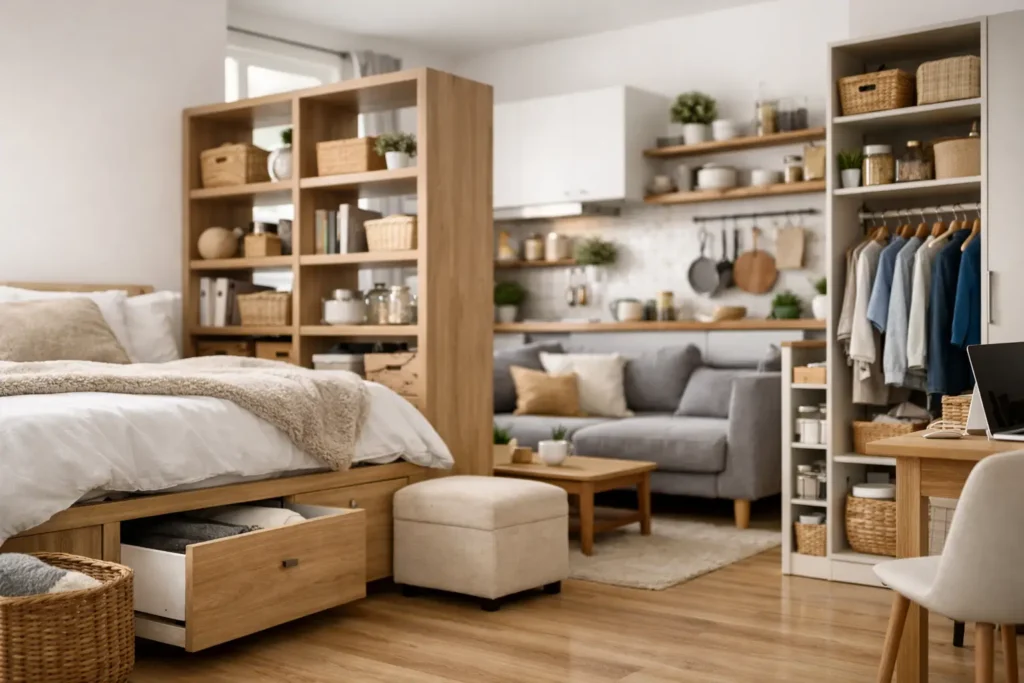
A storage bed is often the biggest win. Drawers underneath can replace an entire dresser, which is especially helpful if your closet is tiny or awkward. Lift-up ottoman beds can hold off-season clothing, extra bedding, and even sentimental items you do not need every day. The trade-off is convenience. Drawers are easier for daily use, while lift-up storage tends to be better for things you access less often.
Coffee tables with hidden compartments are also worth considering, especially if your living area doubles as your work zone. They give you a place to tuck away chargers, notebooks, remotes, and other small items that make a room look busy. The same goes for storage ottomans, benches, and side tables with shelves.
If you host overnight guests, a sleeper sofa with storage can be a smart two-in-one piece. Just make sure the mechanism is easy to use. If opening it feels like a workout, you probably will not love it for long.
Use vertical space without making the room feel heavy
Walls are valuable real estate in a studio, but there is a balance to strike. Too many bulky pieces can make a small room feel top-heavy and boxed in.
Tall, narrow bookcases usually work better than wide, deep units. They store a lot while taking up less floor area, and they draw the eye upward, which can make ceilings feel higher. Open shelving keeps the look airy, but it also requires more visual discipline. If you know you are not going to style every shelf, use a mix of baskets, bins, and closed cabinets so everyday items are not always on display.
Floating shelves can help in overlooked spots such as above a desk, over a dresser, or around a TV. In the kitchen area, adding shelves above a coffee station or microwave can free up precious cabinet space. In the bathroom, shelves above the toilet are a classic small-space fix for a reason.
Hooks deserve more credit, too. A row of wall hooks near the entry can hold coats, bags, and hats without needing a full coat closet. Smaller hooks inside cabinet doors or along a bedroom wall can keep accessories from ending up in random piles.
Make under-bed storage actually usable
Under-bed storage is one of the most common small-space tips, but it only works if it is easy to access. If boxes are heavy, mismatched, or packed too tightly, that area turns into a forgotten graveyard for things you never use.
The better approach is to group items by season or function. Think one container for winter sweaters, one for spare linens, one for holiday decor. Clear bins are practical if you want to see contents at a glance, while fabric containers usually look softer and more homey. Either can work. What matters is consistency and labels.
If your bed sits low, bed risers can create extra inches of storage space, though they are not always the prettiest solution. They make the most sense when function matters more than a tailored look.
Create small zones with storage pieces
One of the trickiest parts of studio living is that everything happens in one open area. Storage can help define each part of the room so it feels less like one big catchall.
A bookshelf placed between the bed and the living area can act as a soft divider while giving you room for books, baskets, and decor. A narrow console behind a sofa can establish a boundary and hold lamps, trays, and work essentials. Even a rolling cart can create a mini kitchen extension or beauty station without committing to a large piece of furniture.
This is where it helps to think beyond traditional categories. A dresser can work as a media console. A bar cart can hold pantry items. A cabinet meant for dining storage can become an entry drop zone. In a studio, function matters more than the label on the furniture tag.
Don’t ignore awkward spaces
The best storage ideas for studio apartments often come from spots that are easy to overlook. That narrow gap beside the fridge, the wall above a doorway, and the empty area under a window can all do more.
Slim rolling organizers are great for tight kitchen gaps and can hold spices, canned goods, cleaning supplies, or water bottles. Over-the-door organizers are helpful in bathrooms, closets, and even kitchen pantries. They are especially useful for renters because they add storage without major installation.
Window benches with storage inside can turn a dead zone into a cozy seat with hidden function. If you have room for only one extra piece, something low and lidded near a window or at the foot of the bed can add both charm and practicality.
Use baskets and bins to control visual clutter
In a studio, visual calm matters almost as much as square footage. Even when you technically have enough storage, too many loose items can make your home feel unsettled.
Matching baskets and bins help because they create rhythm. They make shelves look intentional instead of crowded and give small things a place to land. Woven baskets warm up a room and work well in living areas, while simple fabric or plastic bins are often better inside closets and cabinets.
This is one of those areas where buying fewer, better-fitting containers makes more sense than collecting random ones over time. A coordinated system just tends to work harder and look better.
Edit first, then organize
No storage solution can compensate for too much stuff in too little space. That may not be the fun part, but it is the part that changes everything.
Before buying organizers, look at what you actually use every week. If your studio closet is packed with clothes you do not wear, or your kitchen cabinets are full of gadgets that never come out, the issue may not be storage alone. It may be volume.
Try editing by category instead of by room. Pull out all your mugs, all your skincare, all your cords. Seeing the full quantity at once makes it easier to decide what earns space in your home. Once you have cut down the excess, the right storage choices become much clearer.
A few smart studio storage mistakes to avoid
It is easy to overcorrect when you are trying to get organized. One common mistake is buying large storage furniture that overwhelms the room. Another is filling every open wall, which can make the apartment feel more cramped instead of more functional.
There is also the temptation to hide everything in bins without a real system. If every container becomes a mystery box, clutter is just being relocated. The goal is not to stash things out of sight and hope for the best. It is to make your daily life easier.
A final note for renters: always weigh flexibility against permanence. Peel-and-stick hooks, freestanding cabinets, and rolling pieces may not look as built-in as custom options, but they move with you and usually come with less risk.
A studio apartment can absolutely feel stylish, comfortable, and organized at the same time. You do not need perfect square footage for that. You just need storage that supports the way you really live, so your small space feels less like a compromise and more like home.
Expert Tips for Maximizing Storage in a Studio Apartment
Before investing in new storage products, keep these practical guidelines in mind:
- Prioritize furniture that serves at least two purposes whenever possible.
- Leave a little empty space on shelves instead of filling every inch. A room almost always feels larger when storage has breathing room.
- Store everyday items where you naturally use them. Convenience is more important than perfect organization.
- Use matching baskets or containers to reduce visual clutter and create a more cohesive look.
- Reassess your storage every few months. As your routines change, your storage system should evolve with them.
Final Thoughts From Experience
After looking at hundreds of small-space layouts over the years, one pattern shows up again and again: the most organized studio apartments are rarely the ones with the most storage. They are the ones where every storage solution has a clear purpose.
People often assume they need more shelves, more bins, or bigger furniture. In reality, the biggest improvement usually comes from simplifying first and then choosing storage that supports everyday routines. A drawer that is easy to reach will get used. A basket that fits naturally into your daily habits will stay organized. A complicated system usually won’t.
If I could give just one piece of advice, it would be this: avoid buying storage products until you understand how you actually live in your space. Spend a week noticing where clutter naturally collects. Those spots reveal exactly where your storage needs to work harder.
A studio apartment will always have limited square footage, but it doesn’t have to feel cramped. Thoughtful furniture, smart use of vertical space, and a willingness to keep only what truly adds value can transform even the smallest apartment into a home that feels comfortable, functional, and surprisingly spacious.
About the Author
Fher is an architect specializing in residential design and space optimization. With hands-on experience improving how homes function and feel, he shares practical insights to help homeowners create spaces that are both beautiful and livable.