
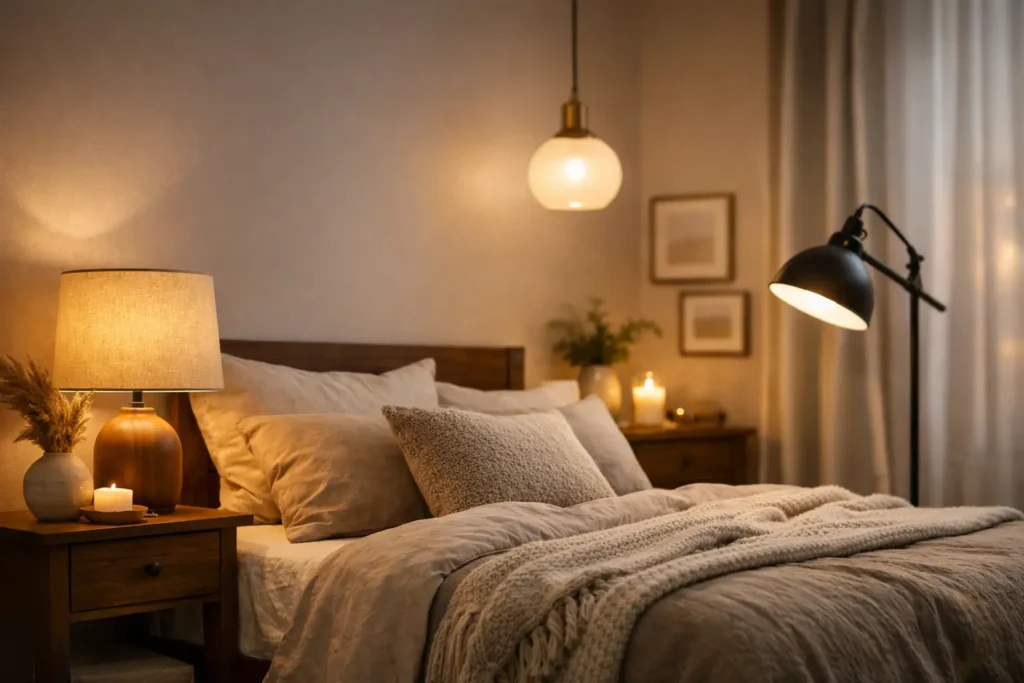

The difference between a bedroom that feels merely furnished and one that truly invites you to exhale often comes down to lighting. This guide to layered bedroom lighting will help you move beyond one overhead fixture and create a room that works for getting dressed, reading in bed, winding down, and enjoying the quiet moments in between.
You do not need a designer budget, a rewiring project, or a perfectly matched lamp set. You need a few intentional light sources, placed for the way you actually use your room. The goal is not to make every corner equally bright. It is to give your bedroom a soft, useful glow that feels personal and flexible from morning to night.
What layered bedroom lighting really means
Layered lighting simply means using more than one kind of light for more than one purpose. In a bedroom, the three layers are ambient lighting, task lighting, and accent lighting.
Ambient lighting is the general illumination that lets you enter the room, make the bed, find clothes, and move around safely. This is often a ceiling fixture, fan light, flush mount, or recessed lights. Task lighting is brighter, more focused light for specific jobs, such as reading, putting on makeup, or choosing an outfit. Bedside lamps, wall sconces, and a vanity light all fit here.
Accent lighting is the cozy finishing layer. It might be a small lamp on a dresser, a picture light over artwork, LED strip lighting tucked under a bed frame, or a warm glow inside a glass-front cabinet. Accent light is not strictly necessary, but it is often what makes a bedroom feel finished rather than flat.
A good layered setup lets each source do less on its own. Instead of relying on one harsh ceiling light for everything, you can turn on only what you need. That is gentler on the eyes and much kinder to the mood of the room.
Start with how you use your bedroom
Before buying anything, think through a normal day in the space. Do you read in bed? Share the room with someone who goes to sleep earlier? Get dressed before sunrise? Work at a small desk in the corner? Your answers should shape the lighting plan more than any trend.
For example, a couple may want two independently controlled bedside lights, so one person can read without lighting up the entire room. A renter with a dark bedroom may need a floor lamp near a dresser because adding hardwired overhead lights is not an option. If your bedroom doubles as a work-from-home spot, task lighting should be a priority instead of an afterthought.
This is also the moment to notice what is not working. If the ceiling light feels sharp at night, the problem may not be the fixture itself. It may be that it is your only source of light. If your nightstand lamp leaves you squinting at a book, it may be too small, too dim, or positioned too far from where you sit.
Build your base with ambient light
Your ambient layer should make the whole room functional without making it feel like a dressing room. In many bedrooms, the existing ceiling fixture handles this job. The easiest upgrade is often changing the bulb and adding a dimmer, if your fixture and home setup allow it.
Choose warm white bulbs in the 2700K to 3000K range for a restful bedroom feel. Lower numbers look warmer and more golden, while higher numbers can look cooler and crisper. Cool white bulbs may make sense in a garage or utility area, but they can make a bedroom feel stark, especially after dark.
If your overhead fixture has exposed bulbs or a frosted glass shade that creates glare, consider a fixture with fabric, paper, ribbed glass, or another diffusing material. A shaded semi-flush mount can give a low ceiling more polish without overwhelming a small room. In a larger bedroom, a pendant or chandelier can create a lovely focal point, but scale matters. A dramatic fixture is only worth it if it leaves enough visual breathing room around the bed.
Renters can still improve ambient lighting without changing a ceiling fixture. A tall floor lamp with a shaded bulb can provide a gentle wash of light, particularly when placed in a dark corner. Plug-in wall sconces are another smart option because they bring light up from the walls without requiring an electrician.
Add bedside task lighting that earns its place
Bedside lighting is where comfort and function meet. A lamp should make it easy to read, reach for water, or find your phone without making your partner feel as if the sun just came up.
Traditional table lamps work beautifully when you have generous nightstands. As a general rule, choose a lamp that feels substantial enough for the table, with a shade that sits around eye level when you are sitting up in bed. This helps direct light downward while reducing glare.
If your nightstands are narrow, wall sconces or pendant lights can free up valuable surface space. Plug-in sconces are especially practical for renters and small bedrooms. Look for swing-arm styles if you read in bed, since you can pull the light closer when needed and tuck it back against the wall afterward.
Matching bedside lights create a calm, balanced look, but they are not mandatory. Two different lamps can work when they share something in common, such as shade color, finish, height, or overall shape. This is a useful approach for budget-conscious decorating because you can use what you already own and add one complementary piece instead of starting from scratch.
For reading, consider bulbs around 450 to 800 lumens, ideally with a shade or adjustable arm that softens the direct view of the bulb. If you only use the lamps for winding down, a lower-lumen bulb or a three-way bulb may feel more comfortable.
Use accent lighting to make the room feel lived in
Once ambient and task lighting are covered, add one or two small sources that make the room feel warm at night. This is the layer that turns a practical setup into a cozy retreat.
A petite lamp on a dresser or chest is one of the simplest choices. It creates visual depth across the room, especially if the bed and nightstands are on one wall and everything else falls into shadow. A small lamp also gives you a low-light option for late evenings when overhead lighting feels like too much.
Consider lighting details that highlight something you love. A plug-in picture light can give framed art more presence. A soft light near a reading chair makes an unused corner feel intentional. LED strips under a bed frame can offer subtle nighttime guidance, though they are best kept warm and dim. Bright color-changing lights can be fun for some spaces, but they do not suit every bedroom style or sleep routine.
Candles can add atmosphere, but they should not be your primary accent lighting. Flameless candles are a sensible choice for a bedside table, shelf, or bedroom with children and pets. You still get the flicker without needing to worry about falling asleep with an open flame nearby.
Control matters as much as the fixture
The most beautiful lamps are frustrating if they are awkward to operate. Make your lighting easy to use from where you need it most.
Put bedside lamps on accessible switches, touch controls, or smart plugs. A smart bulb can be helpful when you want to dim the room from bed or set a gentle morning schedule, but it is not essential. A simple plug-in dimmer can create a similar effect for many lamps at a lower cost.
Think about light switches at the bedroom door, too. If you regularly cross a dark room to turn off a lamp, add a floor switch, remote outlet, or motion-sensor night light. These small changes are not glamorous, but they make a home you love easier to live in every day.
Common layered bedroom lighting mistakes to avoid
The biggest mistake is treating the ceiling fixture as the entire plan. Even a beautiful flush mount cannot provide flattering, flexible light for every bedroom activity. The second is choosing bulbs that are too cool or too bright for nighttime use.
Scale can also throw off an otherwise pretty room. Tiny lamps beside a tall upholstered bed tend to disappear, while oversized lamps can crowd a small nightstand. If you are unsure, use painter’s tape to mark the footprint of a prospective lamp or sconce before buying it.
Finally, do not place every light source at the same height. A ceiling fixture, bedside lamps, and a lower dresser lamp create a more comfortable sense of depth than three lights all sitting at eye level. Layering works visually because the room has pools of light, not one flat blanket of brightness.
A simple guide to layered bedroom lighting on a budget
If you are starting from zero, focus on the highest-impact order: improve your bulb color, add practical bedside lights, then bring in one accent lamp. This three-step approach can transform a bedroom without replacing furniture or installing new wiring.
Shop your home before shopping the store. A lamp from the living room, a thrifted ceramic base with a new shade, or a pair of affordable plug-in sconces can make a meaningful difference. Aim for warm bulbs, convenient controls, and light sources that support your real routines. When your bedroom lighting works with your life, the room becomes more than a place to sleep – it becomes a softer landing place at the end of the day.
Final Thoughts From Experience
One thing I have learned from looking at how people actually use their homes is that good bedroom lighting is less about having beautiful fixtures and more about having the right light in the right place.
It is easy to focus on the appearance of a lamp because it is one of the most visible parts of a bedroom. But a lamp can look perfect in a photograph and still be frustrating if it creates glare, takes up too much nightstand space, or is difficult to switch off from bed.
When I am thinking through a bedroom lighting plan, I would prioritize function first: how the room is used, where people sit or read, what needs to be visible, and which areas become uncomfortably dark at night. Then I would think about the visual side.
For most bedrooms, I would start with three things: a comfortable ambient source, useful bedside lighting, and one additional low-level light somewhere else in the room. You can add more later if the space needs it. There is rarely a reason to solve every lighting problem by buying everything at once.
I would also pay close attention to bulb temperature. A beautiful room can suddenly feel cold or disconnected when one lamp produces warm golden light and another produces noticeably cooler white light. Keeping the bedroom’s main light sources within a similar warm range usually creates a more cohesive feeling, especially in the evening.
And don’t underestimate the value of controls. Being able to dim a light, switch off a bedside lamp without getting up, or turn on a small night light without illuminating the entire room can make a surprisingly large difference in everyday comfort.
If your bedroom currently feels flat, harsh, or unfinished, I would not replace the entire lighting setup. Start by identifying what is missing. Maybe you need focused reading light. Maybe the far side of the room is too dark. Maybe the ceiling fixture is doing too much work. Fix that one problem first, then see how the room feels.
That is really the point of layered bedroom lighting. You are not trying to make the bedroom brighter. You are trying to make it more useful, more comfortable, and more pleasant to live in.
A well-lit bedroom should support the way you actually live in it — from the first light in the morning to the quiet few minutes before you turn in for the night.
About the Author
Fher is an architect specializing in residential design and space optimization. With hands-on experience improving how homes function and feel, he shares practical insights to help homeowners create spaces that are both beautiful and livable.



Really helpfull