
A narrow hallway can feel like the forgotten strip of your home – the place you rush through with laundry in hand, shoes underfoot, and little thought about how it looks. But learning how to style a narrow hallway can change the feeling of your whole home. This small pass-through sets the tone between rooms, and with a few smart choices, it can feel welcoming, useful, and distinctly yours without becoming crowded.
The goal is not to pretend a slim hallway is a grand entry. It is to work with what it does well: creating a moment of color, warmth, personality, or calm as you move through your day. Think edited rather than empty, and choose every piece with both visual breathing room and real-life function in mind.
Start by Protecting the Walking Path
Before choosing art, runners, or furniture, measure the clear space you need to walk comfortably. A hallway should never require a sideways shuffle, especially if it is a busy route between bedrooms, bathrooms, or the kitchen. As a practical rule, keep at least 30 to 36 inches clear where possible. In a very tight rental or older home, simply keeping the route completely unobstructed is the priority.
This is where many well-meant decorating ideas go wrong. A deep console table, a chunky basket, or an oversized plant may look lovely in a wide inspiration photo, but it can turn your own hallway into an obstacle course. Choose shallow pieces, wall-mounted solutions, and décor that has a reason for being there.
If you need storage, look upward and outward rather than into the floor space. Slim wall hooks can hold bags and dog leashes. A narrow picture ledge can display small frames while keeping the floor open. In a family hallway, a row of attractive hooks at a usable height may be more valuable than a decorative table that collects clutter.
Use Color to Create a More Open Feeling
Light colors are often the first recommendation for tight spaces, and for good reason. Soft white, warm beige, pale greige, and muted blue-green shades can help a dim hallway feel less boxed in. Still, a narrow hall does not have to be white to feel good. A deeper color can be wonderfully cozy when you embrace it as an intentional little passage rather than fighting for a larger look.
The difference comes down to light and mood. If your hall gets daylight from nearby rooms, a dusty olive, warm clay, or gentle charcoal can create a charming, cocoon-like transition. If it has no natural light, a warm off-white paired with layered lighting is usually the easier choice. Cool, stark white can look gray and flat under standard ceiling fixtures, so test samples at different times of day before committing.
For a simple visual trick, paint the trim and doors in the same color family as the walls. The reduced contrast makes the hallway feel calmer and less chopped up. On the other hand, if you want a little character, a darker door color against lighter walls can make a long corridor feel thoughtfully designed. It depends on whether your home leans quiet and airy or warm and collected.
Consider Wallpaper on One Intentional Surface
Wallpaper can be a smart choice in a narrow hallway because you do not need much of it to make an impression. A small-scale print, vertical stripe, or soft botanical pattern gives the eye something beautiful to notice as it moves through the space. Avoid a giant, high-contrast pattern in an especially dark hall unless you want a dramatic, moody look.
Peel-and-stick wallpaper can be appealing for renters and commitment-shy decorators, but take your time with installation. Uneven walls, doorframes, and corners can make a quick project feel less quick. A wallpapered end wall is a lower-commitment option that still gives the hallway a focal point.
Choose Lighting That Flatters the Space
A single ceiling light in the center of a long hallway often leaves the ends dark and uninviting. Better lighting makes a bigger difference here than another decorative accessory. Start with warm white bulbs, typically in the 2700K to 3000K range, to keep the space comfortable rather than clinical.
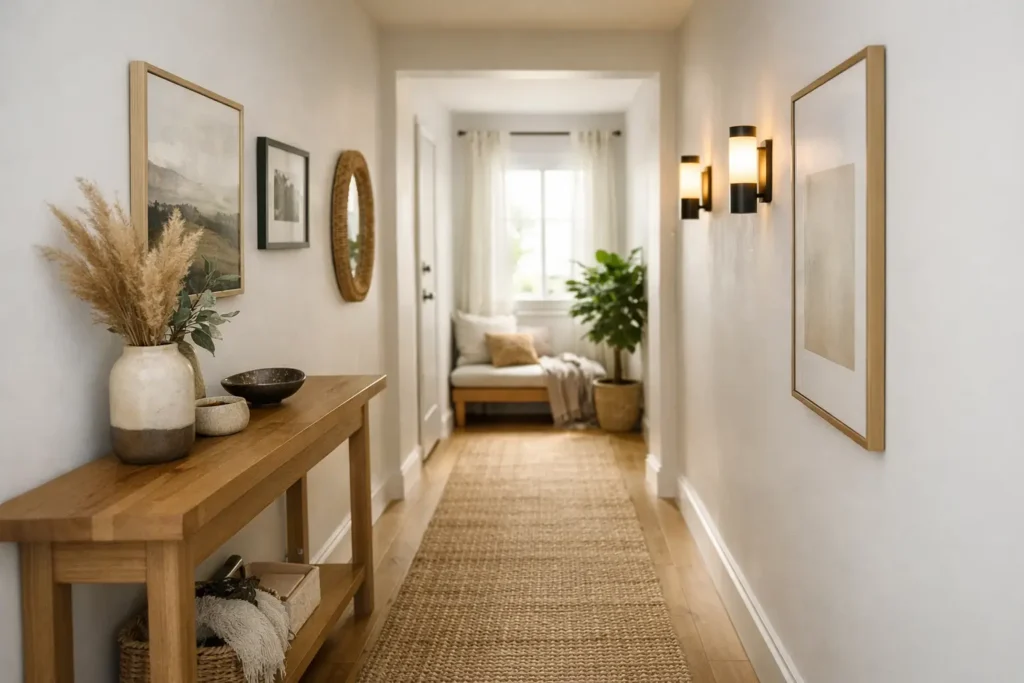
If wiring allows, add more than one light source along a longer hall. Flush-mount fixtures, semi-flush lights, or small sconces are all good options because they do not hang down into the walking space. Sconces are especially helpful beside a mirror or near a doorway, but choose a slim profile so shoulders and backpacks are not brushing against them.
In a rental, plug-in sconces with cord covers can offer a similar effect. Even a thoughtfully placed lamp on a very shallow cabinet can bring softness to a hall, provided it does not interfere with everyday movement. The best lighting is not only bright enough to find your way. It makes the hallway feel like part of the home, not a leftover space.
Add a Runner That Fits, Not One That Fills Every Inch
A runner gives a narrow hallway instant warmth, color, and softness underfoot. It also helps define the hall as a real room with a purpose. The key is scale: leave a border of visible flooring on both sides instead of buying the widest rug that will physically fit. That little bit of floor around the edges keeps the space from feeling squeezed.
For busy households, choose a low-pile, washable, or indoor-outdoor runner that can handle muddy paws, dropped snacks, and constant foot traffic. A subtle vintage-style pattern is forgiving when life gets messy, while a solid runner can bring a clean, calm look to a modern home. Always use a non-slip rug pad, especially near stairs or in homes with kids.
If the hallway has several doors that catch on a rug, measure carefully before buying. A thinner flatweave may be the better trade-off than a plush runner that bunches or blocks a door.
Make the Walls Personal Without Creating Visual Clutter
Long, blank hallway walls practically invite a gallery wall, and this can be a lovely way to bring family photos, travel snapshots, children’s art, or collected prints into daily view. The secret is to treat the arrangement as one composition rather than hanging a few unrelated items wherever there is room.
Choose frames in one or two finishes, then keep the spacing consistent. Black frames can feel crisp and graphic, while natural wood adds warmth. For a softer, more relaxed look, mix frame sizes but repeat a shared detail, such as white mats or a limited color palette in the artwork.
A mirror is another hardworking choice, especially in a hallway without windows. It reflects light from adjacent rooms and gives you one last place to check your outfit on the way out. A tall, narrow mirror works beautifully at the end of a hallway, while a round mirror can soften a space filled with rectangular doors and trim.
Be selective. One large piece of art can make a stronger statement than a dozen small objects. If your hallway already has multiple doors, switches, vents, and frames, a single oversized print or mirror may be the visual relief it needs.
Bring In Storage Only Where It Solves a Problem
The most successful narrow hallway décor usually solves a real annoyance. If shoes pile up by the door, try a slim shoe cabinet designed to tilt open instead of a deep bench. If mail lands on the kitchen counter, a wall-mounted sorter near the entrance may be enough. If coats migrate from room to room, install sturdy hooks and give each family member a designated spot.
Keep open storage attractive by limiting what stays visible. A small tray can corral keys, a lidded basket can hide gloves, and matching hooks make everyday items look more orderly. This is not about making your home look untouched. It is about giving the things you actually use a place to land.
Avoid These Narrow Hallway Decorating Mistakes
A few choices can make even a thoughtfully styled hall feel tighter than it is:
- Furniture that projects too far from the wall or narrows the walkway.
- Dark corners caused by relying on one weak overhead fixture.
- Tiny, scattered décor that reads as clutter instead of a deliberate display.
- A runner that is too wide, too thick, or constantly caught under doors.
- Storage added without a plan, which quickly becomes a drop zone for everything.
When in doubt, remove one item and see how the hallway feels. Small spaces often benefit from a little restraint. You want your favorite details to stand out, not compete for attention.
A narrow hallway does not need to be grand to be memorable. Add the light you wish it had, choose pieces that earn their place, and let a favorite color, print, or family photo bring warmth to the walk from one room to the next. Those quiet in-between spaces are part of home life too, and they deserve to feel like a home you love.
How I Would Approach a Narrow Hallway
When I’m working with a narrow hallway, I don’t start by asking what I can add. I start by asking what is making the space feel difficult in the first place.
Sometimes the problem is simply poor lighting. In other homes, it is too much furniture, a runner that is too wide, or a collection of small decorative pieces that makes an already busy wall feel even busier. A long hallway with several doors may need a completely different approach from a short hallway that opens directly into a living room.
My first step would be to clear the walking path and live with the space for a day or two. Notice where people naturally stop, where shoes and bags accumulate, which areas feel dark, and whether any doors or drawers are difficult to open. Those observations usually tell you more than a decorating photo does.
Next, I would solve the practical problem before adding decorative details. If the hallway is dark, improve the lighting. If it becomes a drop zone for coats and bags, add simple wall storage. If it feels visually chaotic because of multiple doors and trim, simplify the color scheme before bringing in more artwork.
Only after those basics are working would I add the decorative layer.
For most narrow hallways, one strong element is enough to create personality. That might be a beautiful runner, a large mirror, a series of coordinated frames, or an interesting wall color. You don’t necessarily need all four.
This is one of the mistakes I see most often in small spaces: trying to make them feel finished by adding more. In a narrow hallway, editing usually has a bigger impact than decorating harder.
The best result is a hallway where everything has a reason to be there. You can walk through it comfortably, the lighting feels intentional, and the decorative elements give you something to notice without competing with the rest of the home.
Final Thoughts From Experience
A narrow hallway is one of those spaces where small decisions can make a surprisingly big difference. You don’t need to make it look larger than it is. You need to make it work well and feel intentional.
When deciding how to style a narrow hallway, I would always start with circulation and lighting before thinking about accessories. If you cannot walk through the space comfortably or the corners disappear into shadow, another piece of décor is not going to solve the problem.
I also find that narrow hallways benefit from restraint. One well-chosen mirror can do more than several small decorative objects. A properly sized runner can add warmth without overwhelming the floor. A few useful hooks can provide better storage than a piece of furniture that takes up valuable walking space.
The other thing worth remembering is that there is no single formula for every hallway. A dark hallway may benefit from lighter walls and warmer lighting, while a naturally bright corridor can handle a stronger color or more dramatic artwork. The right choice depends on the architecture, the available light, how the hallway is used, and what you want the space to feel like.
If I had to prioritize just three improvements, I would start with these: protect the walking path, improve the lighting, and choose one element that gives the hallway personality. Everything else can be added gradually.
Your hallway may only take a few seconds to walk through, but you experience it many times a day. Making that small transition feel comfortable, organized, and connected to the rest of your home is worth the effort.
About the Author
Fher is an architect specializing in residential design and space optimization. With hands-on experience improving how homes function and feel, he shares practical insights to help homeowners create spaces that are both beautiful and livable.