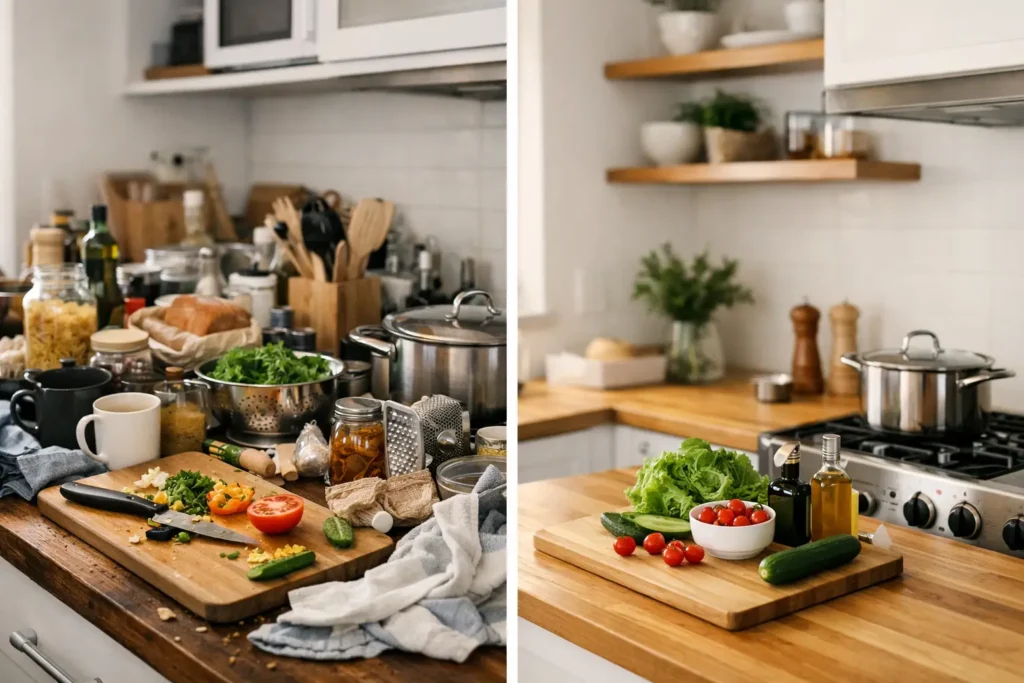

A kitchen can be freshly wiped, dishes put away, and still somehow feel noisy. If you keep asking, “why does my kitchen feel cluttered?” the answer is often less about cleanliness and more about what your eyes have to process every time you walk in.
The good news is that a calmer kitchen does not require a remodel, custom cabinetry, or a strict minimalist lifestyle. It usually comes down to reducing visual traffic, giving everyday items a clear home, and making a few styling choices that support how your household actually cooks, eats, and gathers.
1. Your counters are doing too many jobs
Kitchen counters tend to become landing zones for everything: mail, water bottles, vitamins, school papers, grocery bags, chargers, and appliances. Even useful items can create clutter when they all live out in the open.
Start by looking at your counter in zones rather than as one long surface. Keep only the things you use daily in each zone. Near the stove, that may be a utensil crock and a small tray for cooking oil. By the coffee maker, it might be mugs and coffee supplies. Everything else deserves a cabinet, drawer, pantry shelf, or a different room altogether.
A nearly empty counter is not always practical, especially in a busy family kitchen. The goal is not emptiness. It is intention. When the items that remain are grouped and purposeful, the room feels more settled right away.
2. Too many small items are in view
Visual clutter is often caused by small objects, not large ones. A few spice jars, several bottles, dish soap, scrubbing tools, loose produce, and a stack of papers may each seem harmless. Together, they create dozens of tiny visual stops.
Try containing rather than hiding what needs to stay accessible. Put dish soap and a sponge on a small washable tray. Corral cooking oils on a tray beside the range. Use a basket for snacks or fruit if it regularly lives on the counter. A container creates a boundary, which makes several items read as one organized unit instead of a scattered collection.
This is also a good time to remove duplicate tools. You probably do not need three spatulas on the counter, four half-used hand soaps, or every spice you own beside the stove. Keep the favorites close and store the rest where they are easy to find.
3. Your open shelves may be overcrowded
Open shelving can make a kitchen feel warm, personal, and airy. But it asks more of the items displayed there. When shelves are packed with mismatched mugs, food packaging, random glassware, and decor, they can make the whole kitchen feel busier than it is.
You do not have to style shelves like a showroom. In fact, a real-home approach looks better when it includes useful pieces. Choose a simple color story, such as white dishes, clear glasses, wood accents, and one or two favorite ceramics. Leave a little breathing room between groupings so the shelves feel collected rather than crammed.
If you are a renter or simply prefer open storage, use attractive baskets for the less-pretty necessities. They are especially helpful for tea packets, snack bars, napkins, and extra kitchen linens. What is hidden inside can still be easy to reach.
4. The fridge has become a family bulletin board
A refrigerator covered in invitations, artwork, magnets, schedules, coupons, and takeout menus tells a sweet story about a lived-in home. It can also become the first thing your eye notices when you enter the kitchen.
Instead of removing every personal touch, edit the display. Pick a small section for current papers and rotate children’s artwork rather than adding each new piece to the collection. Move calendars and reminders to the inside of a cabinet door, a nearby command center, or a single framed board.
A clean fridge front can make a surprising difference because it creates one large, quiet surface in the room. If a blank refrigerator feels too stark, keep one meaningful photo or a small piece of art that makes you smile.
5. Your storage is technically full, but not working well
Sometimes clutter is a storage problem disguised as a tidying problem. If putting groceries away feels like a puzzle, or if you have to move five things to reach one pan, your kitchen does not have a clear system for the way you use it.
Think about frequency first. Everyday dishes, lunch containers, and favorite cookware should be in the easiest-to-reach cabinets and drawers. Holiday serving pieces, specialty baking pans, and appliances you use once a month can take the higher shelves or deeper storage spots.
Drawers are especially worth improving because they can hide a lot of frustration. A few inexpensive dividers can keep utensils from mixing together, while a shallow bin can stop food-storage lids from sliding into a messy pile. You do not need matching organizers everywhere. You need simple boundaries that keep categories from spreading.
6. Food packaging is adding more color and noise than you realize
Bright labels, crinkly bags, and assorted boxes are designed to get attention at the store. In your kitchen, that same visual energy can make the pantry, counters, and open shelves feel chaotic.
Decanting every ingredient into matching containers can look beautiful, but it is not necessary for a more peaceful kitchen. It also takes time, costs money, and may not suit a household that goes through groceries quickly. Start smaller: use bins to group snacks, breakfast foods, baking supplies, or lunch items. Turn a few packages so labels face the same direction, and toss anything stale or forgotten.
If you do transfer staples such as flour, rice, or cereal, choose only the products you buy repeatedly. Clear containers are most helpful when they make cooking or grocery planning easier, not when they create another chore.
7. You are trying to store decor and daily life in the same spots
A kitchen should feel welcoming, and a little decor can make it feel like part of your home rather than a purely functional workspace. But when every surface holds a candle, sign, plant, cutting board, bowl, and seasonal accent, the room can lose its sense of calm.
Choose a few details with impact. A small lamp on a counter, a framed print, a bowl of fresh fruit, or a plant near a window can add warmth without competing with your daily essentials. Decorative cutting boards work best when they are leaned together in one intentional spot instead of spread across multiple surfaces.
When deciding whether to keep something out, ask one simple question: does it make the kitchen more useful, more beautiful, or more personal? If the answer is no, it may be better stored elsewhere.
8. The room lacks a simple daily reset
Even a well-organized kitchen will feel cluttered if the day ends with dishes on the counter, backpacks on chairs, and unopened mail by the sink. This is not a sign that you are failing at organization. It is a sign that kitchens are high-traffic rooms.
A five- to ten-minute evening reset can keep small messes from becoming a weekend project. Load or run the dishwasher, clear the sink, put away counter strays, and return chairs to the table. If papers are a repeat problem, place a small basket near the entry point and sort it once a week instead of letting every document stop on the counter.
The reset matters because it gives you a gentler starting point in the morning. A clear sink and a little open counter space can make breakfast, packing lunches, and making coffee feel much less rushed.
A quick way to find what is making your kitchen feel cluttered
Stand at the kitchen entrance and take a photo of the room. Looking at an image helps you notice what your eyes have learned to ignore. You may spot a crowded corner, an overloaded refrigerator, a chair piled with bags, or a countertop appliance you rarely use.
Then make one change that will create the biggest visual relief. Maybe that means clearing one counter, editing the fridge, or moving bulky small appliances into a cabinet. Resist the urge to buy organizing products before you know what needs a home. Decluttering first helps you avoid purchasing containers for items you do not actually want to keep.
A kitchen that feels calm is not one where nothing is visible and no one is allowed to make a mess. It is a kitchen where the useful things are easy to reach, the meaningful things have room to shine, and everyday life has a place to land. Start with one surface today, and let that small bit of breathing room shape a home you love spending time in.
How to Diagnose Kitchen Clutter Before You Organize
Before buying bins, drawer dividers, or matching containers, take a few minutes to figure out what kind of clutter you are actually dealing with. This makes a bigger difference than simply finding more places to put things.
I find it helpful to look at kitchen clutter in three categories.
Functional clutter is made up of things you genuinely use but do not have a good storage system for. Everyday cookware, food containers, small appliances, and cooking tools often fall into this category. The solution is usually better placement, not getting rid of everything.
Visual clutter is different. These are items that may be useful but create a lot of visual activity when they are grouped together. Think of several appliances, colorful food packaging, loose bottles, papers, and small decorative objects competing for attention on the same counter.
Then there is misplaced clutter. These are things that do not really belong in the kitchen but have gradually found a temporary home there. Mail, bags, chargers, toys, and paperwork are common examples.
Once you identify the type of clutter, the solution becomes much clearer. Functional clutter may need better storage. Visual clutter may need editing or grouping. Misplaced clutter needs a home somewhere else.
Before organizing anything, stand at the entrance to your kitchen and look at the room for a few seconds. What catches your eye first? That is usually the best place to start.
And here’s the important part: do not organize everything at once. Fix the area that creates the most visual or functional friction first. A single improved zone can make the entire kitchen feel more manageable.
Final Thoughts From Experience
A kitchen does not have to look minimal to feel organized. In real homes, kitchens are working rooms. People cook in them, leave things on the counter, bring groceries through them, do homework at the table, and inevitably create a little mess. Trying to eliminate every visible item is rarely a realistic solution.
What makes the biggest difference is being selective about what stays visible and making sure the things you use most often are easy to access.
One mistake I often see when organizing a kitchen is starting with storage products instead of starting with the stuff itself. It is tempting to buy a set of matching containers or drawer organizers because they promise an instant transformation. But if you have too many items, better containers simply give the clutter a nicer place to live.
I would start with the surfaces you see first. Clear one counter, edit one shelf, or simplify the refrigerator door. Then live with that change for a few days. Pay attention to what you actually reach for and what keeps coming back to the counter.
That last part matters. Your kitchen should support your routines, not fight them.
If you make coffee every morning, your coffee supplies may deserve to stay together and within easy reach. If you cook most meals from scratch, keeping your favorite utensils and oils close to the cooking area makes sense. If your family tends to drop papers by the kitchen entrance, creating a simple landing spot will probably work better than repeatedly telling everyone to put them somewhere else.
The goal is not to create a kitchen that looks perfect in a photograph. It is to create one that feels easier to use on an ordinary Tuesday.
So if you are still wondering, “Why does my kitchen feel cluttered?”, don’t start by asking what you can hide. Start by asking what your kitchen is asking you to look at, reach around, move, or manage every day.
Then fix the biggest source of friction first.
Sometimes a calmer kitchen really is only one cleared counter away.
About the Author
Fher is an architect specializing in residential design and space optimization. With hands-on experience improving how homes function and feel, he shares practical insights to help homeowners create spaces that are both beautiful and livable.