
The pile on the kitchen counter usually is not just mail. It is a few decisions you have postponed, a school paper you meant to review, a return you forgot to make, and the tiny visual weight of never quite being caught up. Learning how to declutter your home is less about becoming a minimalist and more about making daily life feel lighter in the rooms you already use.
A successful reset does not require matching storage bins, a donated-everything weekend, or a picture-perfect house. It starts with a simple goal: keep the things that support your real life, and make it easier to use, clean, and enjoy the space around them.
Start With a Clear Reason, Not an Empty Room
Decluttering gets exhausting when the only goal is to own less. Give the process a more personal purpose. Maybe you want to cook without moving stacks of papers, help your kids find their shoes on busy mornings, make your living room feel restful again, or finally create a guest-ready corner in a small apartment.
Choose one or two outcomes you want to feel every day. That reason will help when you reach the harder decisions, such as the serving dish you never use but feel guilty donating or the clothes that no longer fit the life you have now.
Then make the project smaller than you think it needs to be. An entire home is too big to hold in your mind, especially if clutter has built up over months or years. Start with a contained zone: one bathroom drawer, the entryway drop spot, the coffee table, or one kitchen cabinet. Finishing a small area creates the momentum that a giant, exhausting plan rarely does.
How to Declutter Your Home One Zone at a Time
Pick a spot that creates friction every day. This is often more motivating than starting in the most dramatic room. If the dining table has become a landing pad for everything, clear it first. If getting dressed means digging through an overstuffed closet, begin with one category of clothing.
Bring out only what belongs in that zone or category, then sort it into a few straightforward groups: keep, donate, recycle or discard, and relocate. A “maybe” pile can be useful for genuinely difficult items, but keep it small. If every decision becomes a maybe, you have simply created a new clutter pile with a more polite name.
Before putting the keepers back, wipe the shelf, drawer, or surface. This small step matters. A clean, open space makes it easier to see how much you truly want to return, and it gives the room that satisfying fresh-start feeling.
Ask Questions That Work in Real Homes
You do not need to ask whether an item sparks joy. Try questions that are more practical for a busy household:
- Do I use this in this season of life?
- Would I buy this again today?
- Is it worth the space it takes up?
- Do I own another item that does the same job better?
- If I needed it, could I easily replace or borrow it?
Sentimental items deserve a gentler approach. Keep the pieces that truly tell your story, rather than every object connected to a memory. A small box of meaningful baby clothes, handwritten notes, or family keepsakes can be far more special than a crowded closet you avoid opening. Taking a photo of an item before letting it go can also preserve the memory without requiring permanent storage.
Work From Visible Surfaces to Hidden Storage
Clear surfaces deliver the quickest visual impact. Start with the kitchen counters, bedside tables, bathroom vanity, coffee table, and entryway. These areas set the tone for a room, and when they are crowded, even a beautifully decorated home can feel unfinished.
The goal is not to leave every surface bare. Your home should still feel personal and lived in. A tray with a candle and a small vase, a favorite cookbook on a kitchen stand, or a few intentional objects on a console can add warmth. The difference is that decor is chosen, while clutter is what accumulates without a job.
Once the visible areas feel calmer, move into drawers, cabinets, and closets. This order is especially helpful in small spaces because it creates immediate breathing room while you decide where everyday items should live. It also prevents the common mistake of buying organizers before you know what you are keeping.
Give Every Keeper a Home That Makes Sense
Decluttering is only half the job. The other half is organizing what remains so it can return to the right place with very little effort.
Store items near where you use them. Mugs belong close to the coffee maker, sunscreen near the door or in a beach bag, and extra linens near the bedrooms or bathroom. If an item is stored too far from its natural use point, it will usually end up on the nearest counter instead.
Make the easiest spaces available for the things you reach for most. Everyday plates should not be on the highest shelf, and the vacuum should not be trapped behind three bins of holiday decor. Put occasional items higher, lower, or farther back. This is a small change that makes a home function more smoothly without spending a dollar.
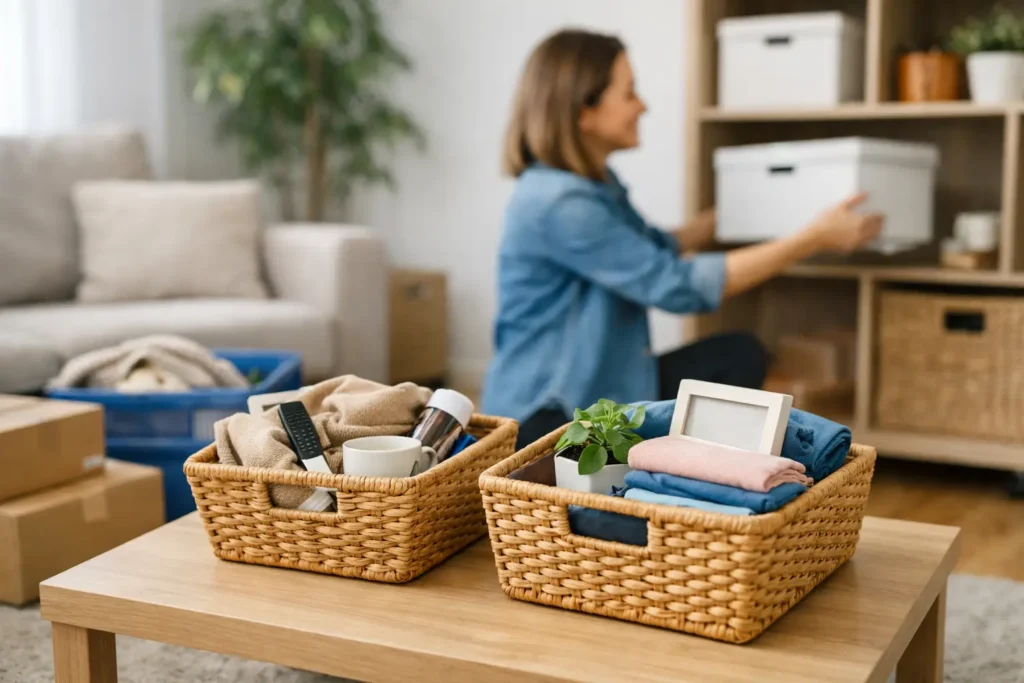
Containers can help, but only after you have edited. Use them to group loose categories, such as charging cords, lunch supplies, pet accessories, or cleaning products. A basket is useful when it gives a category a boundary. It is less useful when it becomes a stylish place to hide everything you do not want to decide about.
Handle the Most Common Clutter Traps
Some categories are difficult because they arrive constantly or carry emotional pressure. Create simple rules for these repeat offenders before they build up again.
Paper is one of the biggest culprits. Set up a single inbox for mail and papers that need action, then recycle junk mail immediately. Keep a short weekly appointment to pay bills, sign forms, and file what truly needs to be saved. Most paper does not need a permanent home, but it does need a quick decision.
Clothes can be challenging because sizes, identity, and wishful thinking all get involved. Keep what fits comfortably now, what you wear often, and what makes getting ready feel good. If you are holding onto a few special pieces while your size changes, give them a clearly defined space and a limit. There is a meaningful difference between a small, hopeful collection and a closet full of clothes that makes you feel behind.
Kids’ items require realistic expectations. Toys, art supplies, and school papers multiply quickly, and children need accessible systems they can actually use. Try a simple toy rotation, keep one display spot for current artwork, and use open bins with broad labels rather than complicated categories. The best organizing system is one your family can maintain on an ordinary Tuesday.
Create a Gentle Maintenance Rhythm
A decluttered home is not one that never gets messy. It is one where messes have an easy path back to order. A ten-minute reset at the end of the day can make a major difference: return dishes, gather stray laundry, clear the entryway, and reset the main surface in the room where everyone tends to land.
Try a one-in, one-out habit for categories that easily overflow, such as shoes, mugs, beauty products, and throw pillows. It does not have to be rigid. A new winter coat does not require you to donate a sentimental sweater that same day. Think of it as a helpful pause before your storage fills beyond what your home can comfortably hold.
Schedule a quick seasonal edit, too. As the weather changes, review outerwear, shoes, pantry staples, bathroom supplies, and decor. This keeps clutter from becoming a major project again and helps your home evolve with how you actually live.
Your home does not need to look empty to feel peaceful. Keep the books you reread, the blanket everyone reaches for, the art that makes you smile, and the practical items that support your routines. When the excess is gone, the things you love get to do what they were meant to do: make your home feel like yours.
Why Most Decluttering Plans Fail
One pattern shows up again and again in homes that never seem to stay organized: people try to solve clutter with storage before they solve it with decisions.
Buying more baskets, drawer dividers, or decorative bins can make a room look neater for a while, but it rarely reduces the amount of stuff competing for space. In many cases, it simply creates prettier places to store items that are rarely used.
Another common mistake is treating decluttering like a marathon. Spending an entire Saturday organizing every room often leads to decision fatigue, frustration, and half-finished projects. A slower approach—one drawer, one shelf, one cabinet at a time—is usually easier to maintain because it fits into everyday life instead of interrupting it.
The homes that stay organized are rarely the ones with the most storage. They are the ones where every item has a purpose, a place, and a realistic chance of being put back after use.
Final Thoughts From Experience
After looking at hundreds of organizing ideas over the years, one lesson stands out: clutter is rarely about a lack of storage. More often, it is the result of small daily decisions that slowly pile up until a room feels harder to use.
The homes that stay organized are not necessarily the biggest, the newest, or the most minimalist. They simply make everyday life easier. When frequently used items have an obvious place, surfaces are kept intentionally clear, and belongings match the way the household actually lives, maintaining order becomes much less work.
If you’re wondering how to declutter your home, resist the urge to tackle everything at once. Start with the area that frustrates you the most, finish it completely, and let that small success build momentum for the next space. Consistent progress almost always creates longer-lasting results than a single weekend of intense organizing.
A comfortable home is not one with the fewest possessions. It is one where your belongings support your routines instead of competing for your attention. That balance is what makes a home feel calmer, easier to maintain, and genuinely enjoyable to live in.
About the Author
Fher is an architect specializing in residential design and space optimization. With hands-on experience improving how homes function and feel, he shares practical insights to help homeowners create spaces that are both beautiful and livable.