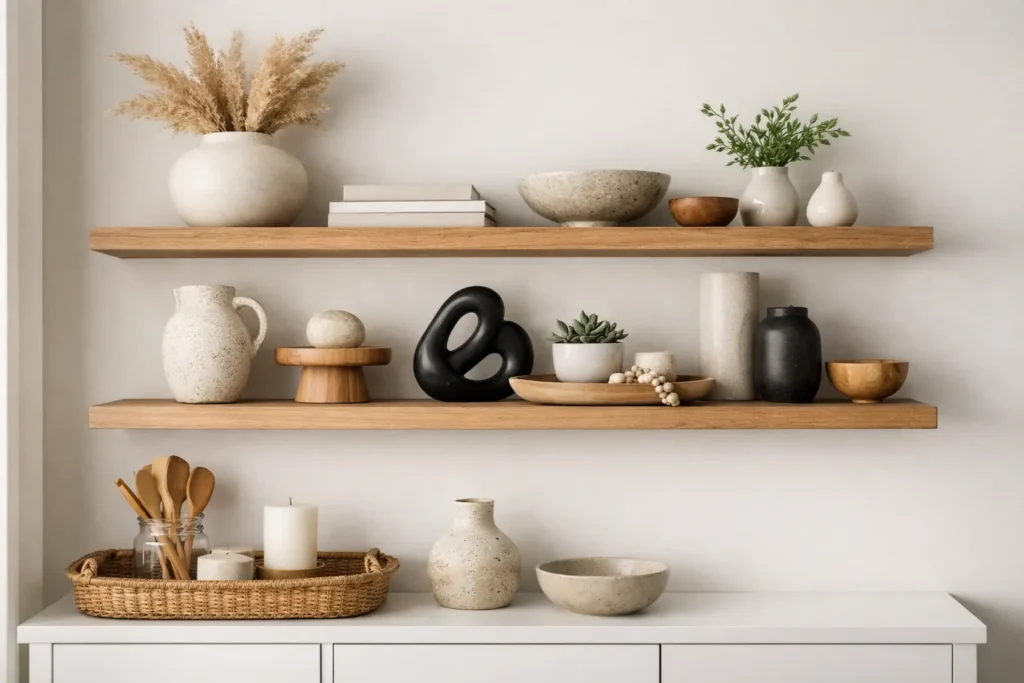

Open shelves can go from charming to chaotic fast. If you have ever placed a few pretty pieces on a shelf, stepped back, and thought, why does this still look messy, learning how to style open shelves usually comes down to one thing: creating intention. The goal is not to fill every inch. It is to make your shelves feel useful, balanced, and lived-in in the best possible way.
That matters whether you are styling kitchen shelving, built-ins in the living room, bathroom shelves, or a small apartment nook that needs both storage and personality. Beautiful open shelving is rarely about buying more decor. More often, it is about editing what you already have and arranging it in a way that gives the eye a place to land.
How to style open shelves with a clear starting point
Before you style anything, take everything off the shelves. It sounds obvious, but it is the step most people skip. Styling is much easier when you are working from a blank slate instead of trying to fix clutter one object at a time.
As you sort through your items, group them loosely into categories: functional pieces, decorative pieces, books, baskets, framed art, and anything that feels seasonal or temporary. This helps you see what you actually have. It also quickly shows you if your shelf problem is really a styling problem or just too much stuff in one place.
If your shelves are in a hardworking spot like the kitchen, function should lead. If they are in a living room or bedroom, you can lean more decorative. Most shelves look best when they do both. A stack of bowls or a row of glassware can be just as attractive as a candle or vase when it is arranged thoughtfully.
Start with larger anchor pieces
The easiest way to avoid a scattered look is to begin with bigger items. Think framed prints, medium baskets, larger bowls, a vase, or a stack of cookbooks. These pieces anchor the shelf and stop everything from feeling like a collection of random little objects.
Place your larger pieces first, spacing them across the shelves so the weight feels visually balanced. You do not want every tall item on one side and every small item on the other. The arrangement should feel relaxed, not perfectly symmetrical, but there should still be a sense of rhythm.
This is where a lot of shelf styling goes wrong. People often start with the cute little accessories, then keep adding more because the shelf still feels unfinished. In reality, the shelf feels unfinished because it is missing structure.
Use the rule of mix, not match
If you want that easy, collected look, resist the urge to make everything identical. Matching bins and decor can work in some spaces, but open shelves usually feel warmer when they include a mix of materials, shapes, and heights.
Try combining wood, ceramic, glass, metal, and woven textures. Pair a smooth white vase with a small stack of linen-covered books. Add a basket next to a ceramic bowl. The contrast is what makes the shelf feel layered instead of flat.
Color matters too, but you do not need a strict palette. A loose color story is often enough. Maybe your shelves lean warm and earthy, or maybe they stay light and neutral with a few darker accents. If every object is a different bright color, the shelf may read as visual clutter even when it is neatly arranged.
How to style open shelves so they feel balanced
Balance is what makes open shelving look calm. That does not mean every shelf needs the same number of items or mirrored arrangements. It means the shelves should feel evenly weighted overall.
A good trick is to vary the composition on each shelf. On one shelf, you might have a stack of books with a small object on top and a vase beside it. On another, a basket on one side and a framed piece leaning behind a smaller decorative item. These little shifts keep the shelves from looking repetitive.
Negative space is just as important as the items themselves. Leaving some empty space gives your favorite pieces room to stand out. It also keeps the shelves from feeling crowded. If you are unsure whether a shelf is done, take one item away before adding another. Editing almost always helps more than filling.
Layer pieces for a more styled look
One of the simplest ways to make shelves feel designed is to layer instead of lining everything up in a single row. Lean a small frame or piece of art at the back, then place a shorter object in front. Set a vase beside a horizontal stack of books. Use a tray or shallow bowl to visually group smaller items.
Layering adds depth, which makes shelves feel more finished and less like storage alone. It also helps everyday items blend in better. A practical canister or pitcher can look decorative when it is part of a layered arrangement.
That said, there is a trade-off. In spots where you use things daily, too much layering can become annoying. Kitchen shelves, for example, still need to work. If you are constantly moving three objects to reach a mug, the styling is not helping your life. Aim for pretty and practical, not precious.
Include functional items that earn their spot
Open shelves do not need to be filled with decor to look good. In many homes, the most successful shelves include plenty of useful pieces. Think dishes, cutting boards, glass jars, folded hand towels, or storage baskets.
The key is choosing functional items that also contribute to the look. Neutral dishes, clear containers, wooden boards, and woven bins tend to style easily because they add texture without looking busy. Even in a budget-friendly home, upgrading a few visible basics can make a big difference.
If you are styling shelves in a small space, this matters even more. Decorative-only shelving is not always realistic when every inch counts. Let your practical pieces do double duty. A pretty basket can hide clutter. A stack of everyday plates can add shape and softness. Good shelf styling should support real life.
Add something organic
Shelves almost always look better with one or two natural elements. A trailing plant, a small branch in a vase, faux stems, or a bowl of fruit can bring life to the arrangement and soften harder lines.
If you do not want the maintenance of real plants, good faux greenery works just fine. The goal is not perfection. It is to keep the shelf from feeling too stiff or overly arranged.
Organic elements also help bridge the gap between functional and decorative items. A shelf with books, baskets, and ceramics can feel a little static until you add something living or natural-looking.
Keep the everyday mess elsewhere
This is the part nobody loves, but it makes the biggest visual difference. Open shelves are not ideal for everything. If you are trying to display paper towels, snack bags, charging cords, medicine bottles, or mismatched plastic containers, the shelf will likely feel cluttered no matter how you style it.
Closed storage exists for a reason. Use cabinets, drawers, or lidded baskets for the less attractive everyday stuff. Open shelves tend to look best when what is visible is either beautiful, useful, or both.
That does not mean your home needs to look staged. It just means being selective about what stays in sight. Real homes need storage, and a polished room usually has a mix of open and hidden spaces.
A simple formula if you feel stuck
If styling does not come naturally, use a repeatable formula. On each shelf, aim for a combination of height, texture, function, and space. For example, you might include one taller item, one practical item, one lower accent piece, and one area left open.
You can also think in small groups. Groups of three often work well because they feel collected without looking too formal. A vase, a book stack, and a candle can be enough. A basket, a framed print, and a small plant can be enough too. You do not need ten objects to make a shelf feel finished.
At Everyday Home Style, we love shelf styling that feels personal rather than overly decorated. A favorite cookbook, a thrifted bowl, or a framed family photo can add more warmth than something bought just to fill a gap.
What to avoid when styling open shelves
A few common mistakes can make even nice shelves feel off. Too many tiny items create visual noise. Decor that is all the same height looks flat. Shelves packed edge to edge feel stressful instead of cozy.
It is also easy to chase trends too hard here. Open shelves should suit your home, not just a photo online. A minimalist arrangement can be beautiful, but in a busy family kitchen it may not be practical. A shelf full of collected treasures can feel charming, but in a small room it might read as clutter. It depends on the space, your storage needs, and how much visual calm you prefer.
The best shelves usually evolve over time. You add a piece, remove another, live with it for a week, then tweak again. That is normal. Styling is rarely one-and-done.
If your shelves still do not feel right, simplify before you shop. Remove half the items, spread out what remains, and look for one or two meaningful pieces to anchor the arrangement. Most of the time, the home you love is already there. It just needs a little breathing room.
Final Thoughts From Experience
One thing that becomes clear after styling shelves in real homes is that the best-looking spaces are rarely the ones filled with the most decor. They are the ones that feel intentional, functional, and comfortable to live in every day.
Open shelves tend to look better when they are edited regularly instead of styled once and forgotten. That is especially true in busy homes where shelves naturally collect extra items over time. Even small adjustments, like removing a few objects, adding more breathing room, or replacing something purely decorative with a functional piece you actually use, can completely change how the space feels.
Another thing many people realize too late is that shelf styling is not about copying a perfectly curated image online. What works in a staged photo may not work in a family kitchen, a small apartment, or a home with limited storage. The shelves that feel the most inviting usually reflect the people living there. Favorite cookbooks, collected ceramics, framed memories, handmade pieces, or practical items used daily often create more warmth than expensive decor ever could.
If your shelves still feel cluttered, resist the urge to buy more accessories. In most cases, simplifying works better than adding. Remove anything that does not serve a purpose, vary the scale of your objects, and leave enough empty space for the eye to rest. That balance between beauty and practicality is what makes open shelving feel timeless instead of overwhelming.
At the end of the day, beautifully styled shelves are not really about perfection. They are about creating a home that feels calm, personal, and easy to live in
About the Author
Fher is an architect specializing in residential design and space optimization. With hands-on experience improving how homes function and feel, he shares practical insights to help homeowners create spaces that are both beautiful and livable.

Pingback: 12 Best Indoor Plants for Low Light - everydayhomestyle.io