

A bedroom can look beautifully decorated and still feel off the second you try to live in it. Maybe the bed blocks the window, the dresser drawers barely open, or the room feels crowded no matter how often you tidy up. If you are wondering how to arrange bedroom furniture in a way that feels calm, functional, and a little more pulled together, the answer usually starts with layout, not decor.
The good news is that you do not need a giant primary suite or a designer budget to fix it. A better bedroom layout often comes down to choosing the right focal point, keeping walking space clear, and being honest about what the room needs to do for your everyday life. A guest room has different priorities than a shared bedroom, and a small apartment bedroom needs a different strategy than a roomy suburban one.
How to arrange bedroom furniture without guessing
Before you move a single piece, pause and look at the room as it is. Notice where you naturally walk, where the light comes in, and what feels cramped. Bedrooms work best when they support rest first, then storage, then style. That order matters more than most people think.
Start with the bed because it is the largest piece and the visual anchor of the room. In most bedrooms, the best place for the bed is on the longest uninterrupted wall. That usually creates the strongest focal point and leaves enough space for movement on both sides. If the room has a clear architectural feature like a centered window, a statement wall, or a wall without doors and closets interrupting it, that is often the right place to begin.
That said, there is no rule that the bed must be centered at all costs. In a narrow room, shifting the bed slightly off-center can free up space for a dresser or create a better pathway. In a very small bedroom, placing one side of the bed closer to the wall may be the smartest choice, even if it is less symmetrical. Perfect balance looks nice in photos, but daily comfort matters more.
Once the bed is placed, test the flow. You should be able to walk from the door to the bed, closet, and windows without weaving around corners or bumping into furniture. If the room feels tight, the issue is often not the room size itself but the way the pieces compete with each other.
Place the biggest pieces first
After the bed, bring in the essential storage pieces. For most people, that means a dresser, nightstands, and maybe a desk or bench. The mistake to avoid is treating every wall as an opportunity to fill space. Bedrooms usually feel better when at least one wall gets a little breathing room.
A dresser should go where drawers can fully open with comfortable standing space in front. If that sounds obvious, it is also one of the most common layout problems. A tall dresser can work well in tighter bedrooms because it gives you storage without taking up as much floor space. A lower, longer dresser may be better under a window, as long as it does not block too much natural light.
Nightstands do not have to match, and they do not even both need to be traditional nightstands. If the room is small, try a slim side table on one side and a small dresser or wall-mounted shelf on the other. That kind of mix often feels more collected and realistic, which fits real homes better than a showroom-perfect setup.
If you want a bench at the foot of the bed, make sure it earns its place. It should not make the walkway too tight or become a landing spot for laundry. In a compact room, skipping the bench can make the entire layout feel lighter.
Common bedroom layouts that actually work
The most practical bedroom layouts are usually the simplest. In a standard rectangular room, centering the bed on the main wall with nightstands on either side and placing the dresser across from the bed is a reliable option. It feels balanced and makes everyday routines easy.
In a small bedroom, pushing the bed against the least disruptive wall may open up more floor space. Then use vertical storage, narrow nightstands, and fewer pieces overall. This is one of those situations where less furniture often makes the room feel more finished, not less.
For an awkward bedroom with multiple doors, angled walls, or off-center windows, focus less on symmetry and more on access. You may need to float the bed away from a window wall or place a dresser in a spot that seems unusual on paper. If the room functions better, it is the right choice.
Shared bedrooms need a little more strategy. If two people use the space, try to give each person reasonable access to the bed and some surface space nearby. That does not always mean equal square footage on both sides, but it should feel fair enough to live with comfortably.
How to arrange bedroom furniture in a small room
Small bedrooms ask you to be selective. The first step is deciding what truly belongs there. If the room cannot comfortably fit a bed, two large nightstands, a dresser, a chair, a desk, and a bench, do not force it. A crowded bedroom rarely feels cozy. It usually just feels busy.
Choose furniture with a smaller footprint and a clear purpose. A bed with under-bed storage can replace a bulky extra cabinet. Wall sconces can free up nightstand space. A narrow dresser can fit where a wider one cannot. Mirrors can help bounce light around the room, but they are not a fix for bad furniture placement.
It also helps to think vertically. Shelves above a dresser, hooks behind the door, and taller storage pieces can give you more function without using precious walking space. Just be careful not to stack the room visually from floor to ceiling. A little breathing room still matters.
One smart trick is to keep the center of the room as open as possible. Even in a tiny bedroom, visible floor space makes the room feel easier to move through and more restful at the end of the day.
Layout mistakes that make a bedroom feel worse
Some bedroom problems have less to do with style and more to do with friction. You feel them every day, even if you cannot immediately name them.
The first is blocking natural pathways. If you have to sidestep a corner every time you walk to the closet, the layout is working against you. The second is using oversized furniture just because you already own it. A dresser that dominates the wall or nightstands that crowd the bed can make the room feel smaller than it is.
Another common mistake is pushing every piece against the wall without considering proportion. Sometimes that works, but sometimes floating one item slightly or leaving a deliberate gap creates better balance. There is also the issue of overfurnishing. Bedrooms do not need as many decorative extras as living rooms. They need enough function to support sleep and storage, then a little softness layered in.
Lighting can also expose a weak layout. If the overhead light is the only source and the bed is far from any practical bedside lighting, the room will never feel as comfortable as it could. Furniture placement and lighting should support each other.
Make the room feel good, not just look correct
Once the main furniture is in place, pay attention to how the room feels during ordinary moments. Can you open drawers easily? Reach your charger? Make the bed without squeezing through a gap? Those small details are what turn a nice-looking room into a bedroom that actually works.
This is also where personality comes in. The most inviting bedrooms are not always perfectly symmetrical or styled within an inch of their life. They feel personal, easy, and a little settled in. Maybe your reading chair fits best in the corner by the window instead of in the far prettier spot across the room. Maybe one nightstand is a small chest because you need the storage. That is not a compromise. That is decorating around real life.
At Everyday Home Style, we love a room that looks polished, but we love it even more when it supports the way you live. Your bedroom should help mornings run smoother and evenings feel calmer.
If you are rearranging and still feel stuck, remove one piece before adding another. Bedrooms almost always improve when the layout gets simpler. A little space around your furniture can do more for the room than one more decorative item ever will.
The best bedroom arrangement is the one that lets you walk in, exhale, and feel like your home is taking care of you a little better.
Before You Buy New Furniture, Measure First
One mistake I see surprisingly often is trying to solve a layout problem by buying more furniture before understanding the room itself. A bedroom can feel awkward not because it lacks storage, but because the existing pieces are simply too large for the space.
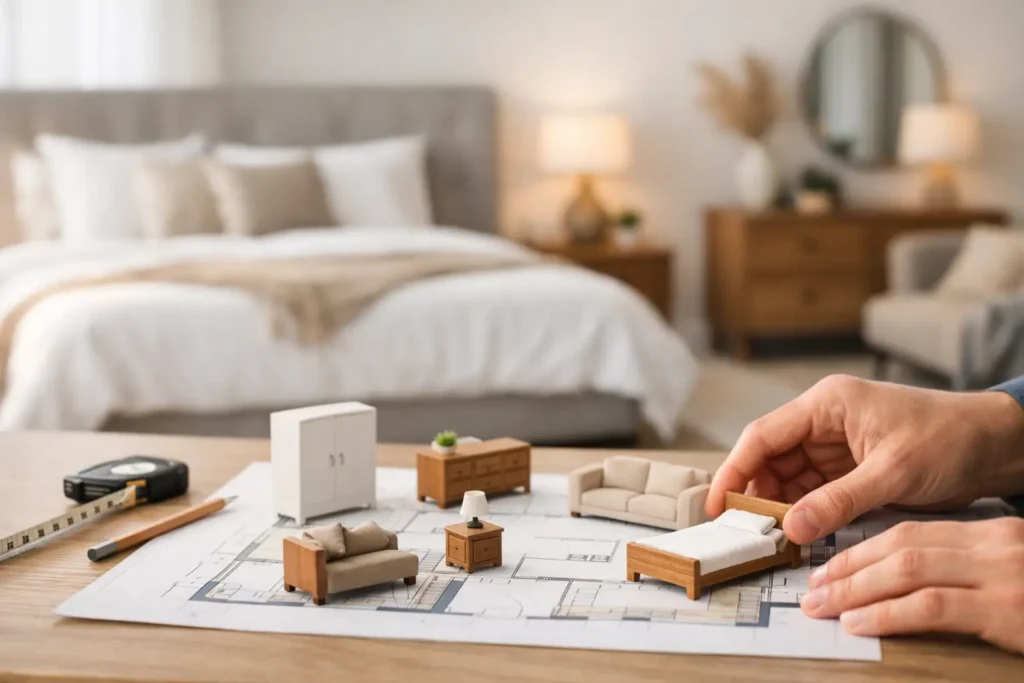
Before replacing anything, measure the room and make a simple floor plan. Include doors, windows, and closet openings. Then measure the bed, dresser, and any additional furniture you plan to keep. Even a rough sketch can help you avoid expensive mistakes.
In many cases, removing one oversized piece or choosing a narrower nightstand improves the room more than buying an entirely new bedroom set. Good layouts are usually the result of thoughtful proportions, not more furniture.
Quick Bedroom Layout Checklist
Before you call the layout finished, ask yourself:
- Can I comfortably walk from the door to the bed and closet?
- Do dresser drawers open fully?
- Can I make the bed without squeezing through narrow gaps?
- Is there enough lighting near the bed for reading or charging devices?
- Does every piece of furniture serve a purpose?
- Is there enough visible floor space to make the room feel open?
If the answer to most of these questions is yes, your bedroom layout is probably working better than you think.
Final Thoughts From Experience
Over the years, one thing I have noticed is that bedrooms rarely feel uncomfortable because they are too small. More often, they feel uncomfortable because the layout is fighting against daily life.
People sometimes assume they need a bigger room or a completely new bedroom set when what they really need is a little more breathing room and a layout that supports how they actually live. I have seen small bedrooms feel surprisingly peaceful simply because the furniture was arranged with movement and function in mind.
Another lesson I keep coming back to is that there is no single “perfect” bedroom layout. What works for a guest room may not work for a shared bedroom, and what looks beautiful in a magazine might feel frustrating in real life. Your habits matter more than symmetry, and comfort matters more than following decorating rules.
If you are rearranging your bedroom, do not focus on making it look picture-perfect right away. Start by making everyday tasks easier. Make sure you can move around comfortably, reach what you need, and enjoy a sense of calm when you walk into the room.
In my experience, the most welcoming bedrooms are not necessarily the most expensive or the most perfectly styled. They are the ones that feel restful, functional, and genuinely lived in. And sometimes, creating that feeling is as simple as moving one piece of furniture and giving the room a little more space to breathe.
About the Author
Fher is an architect specializing in residential design and space optimization. With hands-on experience improving how homes function and feel, he shares practical insights to help homeowners create spaces that are both beautiful and livable