
That tired living room usually does not need a full renovation. More often, it needs a sharper plan. A budget friendly living room makeover works best when you stop thinking in terms of buying all new everything and start looking for the few changes that will actually shift how the room feels, functions, and looks day to day.
If your space feels flat, crowded, mismatched, or just a little uninspiring, you are not alone. Living rooms tend to collect random furniture, leftover decor, and habits from past seasons of life. The good news is that even a modest budget can create a room that feels calmer, cozier, and more pulled together when you focus on the upgrades with the biggest visual payoff.
Start your budget friendly living room makeover with a reset
Before you buy a single pillow or paint sample, clear the room as much as possible. Remove decor that no longer fits, stack extra baskets or side tables elsewhere, and take a hard look at what is actually earning its place. This step costs nothing, but it changes everything because it helps you see the room clearly.
A reset also helps you notice the real problem. Sometimes the issue is not that the sofa is outdated. It is that the layout blocks the walkway, the walls feel bare, or the room has too many small accessories and no focal point. Once you identify what feels off, your money goes further.
Take a few photos of the room before you begin. Pictures are useful because they show awkward corners, uneven balance, and clutter hot spots in a way your eyes often miss when you live with a space every day.
Rearrange the layout before you shop
One of the most overlooked makeover tools is simply moving furniture. If your sofa is pressed against the wrong wall or your chairs are too far apart to feel conversational, the room can seem uncomfortable even if the furniture itself is perfectly fine.
Try pulling seating slightly inward rather than lining everything around the perimeter. Shift a chair toward a window. Move a floor lamp into a dark corner. Angle a side table where it is more useful. Small layout changes can make a room feel more intentional without spending a dime.
This is also the moment to remove anything oversized. A huge coffee table in a small apartment living room may be doing more harm than good. On the other hand, a room that feels empty may need one larger anchor piece instead of several little ones. It depends on your square footage and how you actually use the room.
Paint is still one of the cheapest high-impact updates
If your walls are scuffed, dull, or painted in a color that fights the rest of the room, a fresh coat of paint can do more than almost any accessory. Soft warm whites, gentle greige tones, muted greens, and light taupes tend to work well for everyday living because they feel cozy without making the room dark.
If painting the whole room is not in the budget or feels too time-consuming, paint just one feature. A TV wall, built-in shelf, old side table, or dated media console can look dramatically better with the right color. Even painting trim or a front-facing bookshelf can help the room feel cleaner and more current.
The trade-off is that paint shows best when the room is somewhat edited. If the space is still crowded and visually noisy, fresh paint alone will not solve it.
Focus on textiles for instant warmth
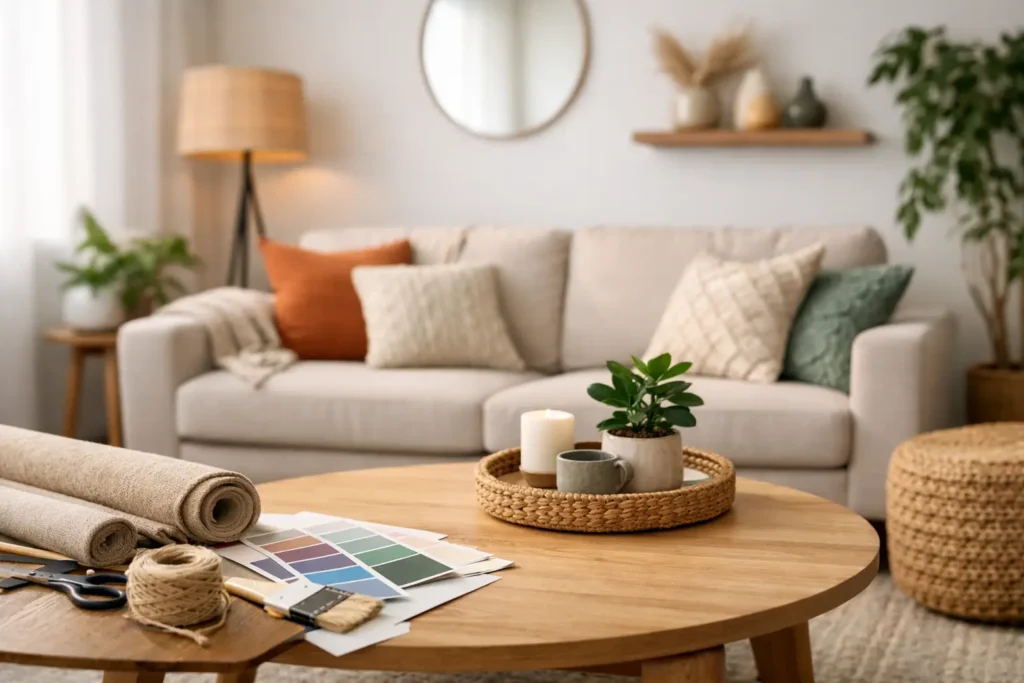
When people want a living room to feel finished, they often go straight to decor objects. In reality, textiles usually do more of the heavy lifting. Curtains, pillows, and an area rug soften a room, add color and texture, and make furniture look more considered.
If you can only update one thing, start with the rug. A rug that is too small can make the whole room feel disconnected. Ideally, at least the front legs of your seating should sit on it. This creates a more grounded layout and makes even budget furniture look better.
Curtains are another upgrade that can change the mood fast. Hang them a little higher and wider than the window frame so the room feels taller and the windows look more generous. Choose simple panels in linen-look or cotton fabrics for an easy, relaxed finish.
With pillows, less is often better. Two or three coordinated options in varied textures usually look more polished than a pile of random patterns. Try mixing a solid, a subtle stripe, and a nubby or woven texture in a palette that relates to the rug and wall color.
Budget friendly living room makeover ideas that look custom
The room feels more expensive when it has contrast, scale, and a little personality. That does not require designer prices. It requires choosing pieces that look intentional.
Wall art is a good example. A single oversized print, framed fabric panel, or set of cohesive thrifted frames often looks better than lots of tiny scattered pieces. If you already own art that does not quite work, consider reframing it in matching frames or using larger mats to give it more presence.
Lighting matters just as much. Swapping a dated lamp shade, adding a floor lamp in a dim corner, or using warmer light bulbs can make the whole room feel softer at night. Many living rooms rely too heavily on one overhead fixture, which tends to flatten the space. Layered lighting feels more inviting and is usually inexpensive to build over time.
Decorative trays, stacked books, woven baskets, and greenery can add style, but they work best after the big pieces are right. Think of accessories as the finishing touch, not the fix.
Shop your home first, then use secondhand sources
A smart makeover rarely starts at a big-box checkout. Look around your home for pieces you can repurpose. A stool from the bedroom might become a side table. A lamp from the office might work better in the living room. A throw blanket stored in a closet may be exactly what the sofa needs.
After that, check thrift stores, estate sales, flea markets, and local resale apps. Living rooms are one of the easiest spaces to decorate secondhand because side tables, mirrors, frames, baskets, and solid wood furniture often show up for far less than retail prices.
The key is to shop with a short list. If you go in looking for anything cute, you may come home with more clutter. If you go in looking for a narrow wood side table, a large mirror, or a textured neutral rug, you are more likely to make choices that support the room.
Choose a simple color palette and repeat it
A room starts to feel pulled together when colors repeat across the space. That does not mean everything should match. It means there should be a clear thread connecting the sofa, pillows, art, rug, and smaller accents.
For most homes, a simple palette works best: a main neutral, a secondary warm or cool tone, and one accent color. For example, cream, camel, and muted olive can feel soft and grounded. Gray, white, and dusty blue can feel crisp and calm. If your furniture is already busy, keep the palette especially restrained.
This is one place where restraint saves money. When you stop chasing every trend color, it becomes easier to reuse what you have and buy only the pieces that truly fit.
Don’t ignore storage in a living room makeover
Sometimes a living room looks unfinished because too much everyday stuff is visible. Remotes, toys, charging cords, blankets, mail, and random odds and ends can make even pretty decor disappear into the background.
Closed storage helps, but open storage can work too if it is edited. A basket for throws, a tray for remotes, and a shelf with room to breathe can make the space feel calmer without making it look overly styled. If you have kids or a small home, storage that doubles as decor is especially helpful.
This is where practicality matters. A room that looks great for one photo but cannot handle your real life will not feel good for long. Everyday Home Style readers know the goal is not perfection. It is creating a home you love living in.
Know where to spend and where to save
If your budget is tight, spend on the pieces that affect comfort or scale. A better rug, fuller curtains, or a lamp that improves lighting often does more for the room than trendy decorative objects.
Save on accents, simple art, thrifted tables, pillow covers, and DIY updates. You can also phase the makeover over a few weeks instead of trying to finish everything at once. That usually leads to better choices anyway, because you can live with each change and see what the room still needs.
A thoughtful living room makeover does not have to be dramatic to feel meaningful. Sometimes the biggest shift comes from a cleaner layout, softer light, a better rug, and fewer things competing for attention. When your space starts to feel easier, warmer, and more like you, that is when the makeover has really worked.
##Final Thoughts From Experience
One thing I have noticed after seeing countless budget living room makeovers is that the rooms people end up loving most are usually not the ones with the biggest budgets. They are the ones that feel intentional, comfortable, and realistic for everyday life.
A lot of homeowners make the mistake of trying to transform everything at once. In practice, the best results usually come from slowing down and focusing on the changes that truly affect how the room feels to live in. Better lighting, a more balanced layout, softer textures, less visual clutter, and a cohesive color palette often have more impact than constantly buying trendy decor.
Another lesson worth remembering is that a beautiful living room does not need to look perfect all the time. Real homes evolve gradually. Some of the most inviting spaces are layered over months or even years with a mix of practical upgrades, secondhand finds, meaningful pieces, and small improvements that make daily routines easier.
If your living room currently feels unfinished or disconnected, start with one area instead of the entire room. Improve the lighting. Replace the rug. Rearrange the seating. Clear visual clutter. Those smaller decisions tend to build momentum, and over time they create a space that feels warmer, calmer, and far more personal than a rushed makeover ever could.
In the end, a successful budget friendly living room makeover is not really about making the room look expensive. It is about creating a space that feels comfortable to come home to every single day.